The first of the three dates engraved on Rav Kook’s tombstone in the Mount of Olives cemetery is the 28th of Iyyar, 5664 (1904). This was a deeply significant date in Rav Kook’s life: it marked the day he was privileged to ascend to the Land of Israel.
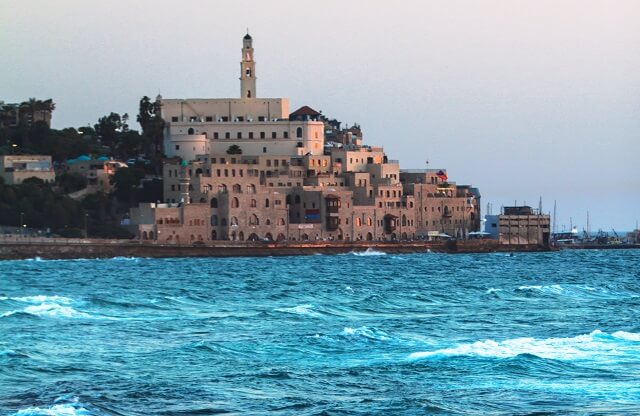
On the 28th of Iyyar — the same date on which, 63 years later, Jerusalem would be reunited — a ship docked at the port of Jaffa, bearing Rav Kook and his family.
The New Rabbi of Jaffa
Jaffa’s previous rabbi had passed away two years prior. R. Yoel Moshe Solomon (1838-1912), a pioneering figure in Jerusalem and one of the founders of Petach Tikva, was among the first to suggest that Rav Kook, then rabbi of Bausk, be offered the position. Solomon brought the proposal to Rabbi Eliyahu David Rabinowitz-Teumim (commonly referred to as ‘Aderet'), the chief rabbi of Jerusalem and Rabbi Kook’s father-in-law.
That very day, the Aderet sent an urgent message to his son-in-law advising him to accept the position of rabbi of Jaffa and its surrounding communities. Rabbi Kook was delighted with the suggestion, but wanted to know what Rabbi Shmuel Salant, the previous chief rabbi of Jerusalem and its elder statesman, thought about the proposal. The Aderet reported that when he queried Rabbi Salant, the scholar happily responded, “If only!”
The Aderet later noted with irony, “In truth, my son-in-law should have been appointed the rabbi of the holy city of Jerusalem, and I should have been the rabbi of the small town of Jaffa.” Fifteen years later, Rav Kook in fact did become the chief rabbi of Jerusalem.

The Arrival in Jaffa
Despite the insistence of the community of Bausk that their beloved rabbi not abandon them, Rabbi Kook saw in the Jaffa position a fulfillment of his long-cherished dream to live in Eretz Yisrael.
In the early summer of 1904, Rabbi Kook and his family journeyed to pre-state Israel through Odessa. On the beach in Jaffa, they were greeted enthusiastically by the community. R. Yoel Moshe Solomon, along with other public figures who had worked to secure the appointment, set out in a small boat to greet the new rabbi.
The weekly newspaper Ha-Hashkafah described the momentous occasion:
On Friday, the 28th of Iyyar, our new rabbi made his debut in our town.... He was greeted with great honor by members of the community from all sections of the population. Messengers arrived from Jerusalem to welcome him in the name of Rabbi Shmuel Salant and the Aderet. Delegates also came from the villages of Rishon Letzion, Petach Tikvah, and so on, to greet their new rabbi.
Prominent representatives from the Sephardic community also arrived, and he spoke with them in pure Hebrew. It is rare to find an [Ashkenazic] rabbi with such a command of pure, fluent Hebrew. On the Sabbath morning, the rabbi spoke eloquently with a clear, unadulterated Hebrew, and the Sephardic Jews also understood his words and enjoyed the sermon.
Even the Chabad Chasidim expressed their opinion that they consider the new rabbi to be the best possible choice. They concluded that such a rabbi was on par with the rabbis of the greatest cities of the world, due to his great wisdom and erudition.... They also consoled themselves, that even though the new rabbi was educated in non-Chasidic yeshivot, on his mother’s side he is descended from Chabad Chasidim, and is endowed with several Chasidic qualities.

Footsteps in the Sand
Rav Kook’s exceptional appeal to all sectors of the city is evident in the picturesque testimony of the painter Nachum Gutman (1898-1980). Gutman, known as “the artist of early Tel Aviv,” arrived in Jaffa in 1905 and spent his childhood living close to Rav Kook’s home in Jaffa’s Neve Tzedek neighborhood.
Rav Kook’s house was located a few hundred steps from our home, enclosed with a whitewashed fence. The courtyard had a gate, and contained a small garden and a well of water. Just the sight of the house exuded an atmosphere of serenity and joy. Through its open windows we could hear the sounds of Jews studying Torah. And when the figure of Rav Kook would appear in the opening of the gate, as he readied himself to walk to synagogue — this image would always take my breath away.
As a child, I adored him for his beauty, his noble serenity, and his unwavering poise. I was so fascinated by him that I would literally follow after him, placing my feet in the footprints he left in the sand.... I never met another man like that, a rabbi who knew how to attract people from all sectors and factions. What a remarkable figure he was!
(Stories from the Land of Israel. Adapted from Encyclopaedia of Religious Zionism, vol. V, pp. 110-111)