The Akeidah, the Binding of Isaac, was over. Abraham had passed this extraordinary test. He descended from the heights of Mount Moriah — physically and spiritually. The Torah concludes the narrative with a description of Abraham’s return to the world:
“Abraham returned to his young men; and they rose and went together to Beersheba. And Abraham lived in Beersheba.” (Gen. 22:19)
Why does the Torah mention that Abraham rejoined the young men he had left behind with the donkey? And why the emphasis on his return to Beersheba and his settling there?
Rejoining the World
The powerful experience of the Akeidah could have caused Abraham to disengage from the world and its mundane ways. The extraordinary spiritual encounter on Mount Moriah might have led him to forgo the battle against ignorance and idolatry in the world and withdraw to live a secluded life dedicated to his private service of God.
However, this did not happen. Every word in the text emphasizes the extent of Abraham’s return to society after the Akeidah.
“Abraham returned to his young men.” Abraham did not relinquish his mission of influencing and educating others. Before ascending Mount Moriah, Abraham had instructed the young men to stay behind. They were not ready for this supreme spiritual ascent. They needed to stay with the donkey- in Hebrew, the chamor – for they were not ready to sever all ties with their chomer, their materialistic life.
But now Abraham returned to them. He descended to their level in order to enlighten and elevate them.
“They rose and went together to Beersheba.” They rose — with elevated spirits, in an atmosphere of purity and holiness. And the most remarkable aspect of Abraham’s return was that, despite everything that had taken place at the heights of Mount Moriah, Abraham and the young men were able to proceed together — united in purpose and plan of action — to Beersheba.
Beersheba
What is the significance of their journey to Beersheba?
The name “Beersheba” has two meanings. It means “Well of Oath” and “Well of Seven.” An oath is a pledge to take action. When we take an oath, we vow that our vision will not remain just a theoretical ideal; we promise to translate our beliefs into action.
The number “seven” signifies completion of the natural world. It took seven days to finish creating the universe. Beersheba is thus not just a location. It is a metaphor for Abraham’s commitment to apply his convictions and ideals in practice.
“Abraham lived in Beersheba.” Abraham stayed in Beersheba, continuing his outreach activities there. His name Abraham — meaning “father of many nations” – was particularly appropriate in Beersheba. There he set up his eshel, an inn that brought wayfarers to recognize God’s providence and to “call in the name of God, the Eternal Lord” (Gen. 21:33).
Where was Isaac?
While the Torah describes Abraham’s return, it is mysteriously silent about Isaac. What happened to Isaac after the Akeidah?
Concealed behind Abraham’s public works was a hidden ray of light. This light was Isaac’s unique trait of mesirut nefesh, the quality of total devotion and self-sacrifice that he had demonstrated at the Akeidah.
While Abraham’s activities were directed towards all peoples, Isaac passed on this legacy of mesirut nefesh to his descendants, a spiritual gift to the Jewish people for all generations.
(Sapphire from the Land of Israel. Adapted from Olat Re’iyah vol. I, pp. 96-97)
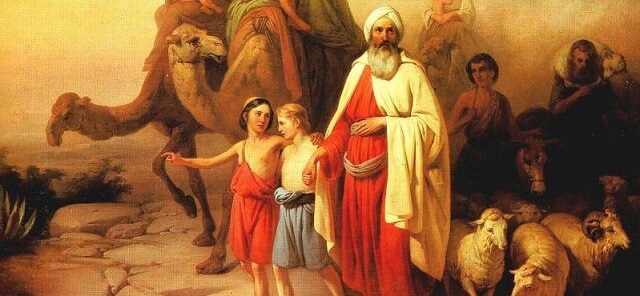
Illustration image: Abraham with his family and flocks. József Molnár (1821–1899), Hungarian National Gallery.