Gifts of Meat
One of the lesser-known ways that the Torah provides for the support of the kohanim in their holy activities is through gifts of certain cuts of meat:
This shall be the kohen’s due from the people: when an ox or sheep is slaughtered for food, they shall give the kohen the foreleg, the jaw, and the maw [the last of a cow’s four stomachs]. (Deut. 18:3)
Rav Hisda’s Offer
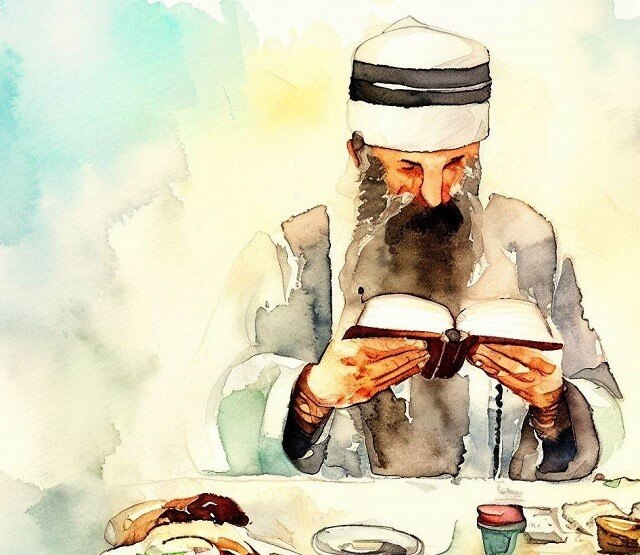
While this gift belongs to the kohanim, they do not have to eat it themselves. The Talmud (Shabbat 10b) recounts that Rabbi Hisda, fourth-century Babylonian scholar and a kohen, found an original use for his gifts of meat. Rabbi Hisda held up two portions of priestly gifts and announced, “I will give this beef to whoever will come and teach me a new dictum of Rav.” (The great Talmudic scholar and leader of Babylonian Jewry, Abba Aricha (160-248 CE) was known simply as “Rav” (“the Master”) due to his stature as the preeminent scholar of his generation.)
The scholar who won the prize was Rava bar Mahsia, who quoted Rav’s statement that one should inform his neighbor when giving him a gift.
Why does the Torah reward the kohanim with gifts of meat? And is there some connection between the prize offered by Rabbi Hisda and the dictum quoted by Rava bar Mahsia?
Permission to Eat Meat
To answer these questions, we need to examine the moral dilemma regarding the slaughter of animals for food. The Torah expresses a certain reservation in the matter; its acquiescence to allow eating meat appears to be a concession to the baser side of human nature. Thus, the Torah adds the otherwise superfluous phrase, “When you desire to eat meat” (Deut. 12:20), implying that when you have a strong craving for animal flesh, you need not suppress this desire. Were it not for this craving, however, it would be preferable to refrain from eating meat.
Why then are we allowed to kill animals for food? The Torah recognizes that, given our current state of weakness, both moral and physical, we would be unable to perfect ourselves if we were to deny ourselves those foods that give us strength. Merely for the sake of our physical welfare, we would not be justified in taking the life of an animal. In time, however, the spiritual advance of humanity will bring about the overall elevation of the entire universe, including the animals. Therefore, it is reasonable that the animals should also make their contribution during this interim struggle, until the world attains its desired goal.
Meat and Wisdom
Given this understanding of the Torah’s attitude towards eating meat, it is clear that this consent is linked to mankind’s intellectual and moral progress. This is particularly true regarding the development of new knowledge in Torah and wisdom, which has a direct impact on advancing the world.
For this reason, we find the Sages counseled, “An ignoramus should not eat meat” (Pesachim 49b). Since an ignoramus does not contribute to the world’s spiritual advance, he is not justified in taking an animal’s life for his food.
This also explains the purpose of the gifts of meat that the Torah decreed be given to the kohanim. The major source of income for the kohanim are tithes, which (by Torah law) are only taken from basic staples — grain, oil, and wine. Why did the Torah also give these cuts of meat, a nonessential food of indulgence, to the kohanim? This confirms the premise that the Torah permitted meat in order to promote the activities of scholars and holy teachers, so that they may expand their wisdom and help advance the world’s spiritual growth.
For this reason, Rabbi Hisda used his portions of beef as a reward for a new teaching. Particularly regarding beef, the Talmud (Baba Kama 72a) ascribes properties of increased intellectual powers. Rabbi Hisda wanted to use his gift of meat for its true purpose, to gain wisdom and new Torah knowledge, so he announced, “I will give this beef to whoever will come and teach me a new dictum of Rav.”
But why did Rabbi Hisda hold up two portions of beef?
Rabbi Hisda realized his efforts to amass the sayings and wisdom of Rav would be rewarded doubly. First comes the benefit gained by learning any new word of wisdom. The second benefit is the result of collecting together all of the statements of an eminent scholar. By bringing together all of the sparks of light that illuminate his teachings, we can uncover a complete picture of the great individual’s unique approach, enabling us to follow in his spiritual path.
Private versus Public Good
Our last question was why did Rava bar Mahsia relate to Rabbi Hisda this particular dictum, that one should inform his neighbor when giving him a gift?
Rav’s statement deals with an interesting moral dilemma. On the one hand, a person who truly loves doing chesed and helping others prefers that his actions go unnoticed. In this way, the beneficiary will not express his appreciation, and the kindness is performed in a completely sincere and altruistic manner.
On the other hand, it is important for the moral development of the world that people develop and deepen their powers of appreciation. The trait of hakarat ha-tov brings genuine good to the world, uplifting our lives. So, which value should prevail: the ethical benefit of the individual, or the moral need of the world?
Rav taught that the overall benefit of the world takes precedence over that of an individual. Thus, when giving a gift, the recipient should be informed.
This teaching neatly corresponds to the moral dilemma regarding eating meat. A sensitive individual will feel some moral aversion to the slaughter of animals, even for food. The Talmud (Baba Metzia 85a) relates that Rabbi Yehudah HaNasi was punished when he failed to show proper sensitivity towards a calf about to be slaughtered, telling it, “Go! For this purpose you were formed.” Such a spiritual giant should have been appreciative of all ethical sensitivities. Even though the world may not yet be ready for vegetarianism, these aspirations should nevertheless be given their due place.
But in the end, as with the case of giving a gift, the spiritual needs of society come first. The need to permit meat in order to promote humanity’s intellectual and spiritual progress takes precedence over any private moral considerations.
(Gold from the Land of Israel. Adapted from Ein Eyah vol. III, pp.14-15)