Rabbi Meir, the second-century scholar, had a serious problem. Neighborhood thugs were making his life miserable. Desperate for a way to stop their harassment, Rabbi Meir decided that drastic measures were called for. He decided to pray that the ruffians would die.
But Bruriah, Rabbi Meir’s wife, was not pleased with this solution. Bruriah quoted to her husband the verse in Tehillim:
"יִתַּמּוּ חַטָּאִים מִן-הָאָרֶץ, וּרְשָׁעִים עוֹד אֵינָם “
Let sins be uprooted from the earth,
and the wicked will be no more. (Psalms 104:35)
It doesn’t say “Let חוֹטְאִים (sinners) be uprooted,” Bruria pointed out. It says “Let חַטָּאִים — their sins — be uprooted.”
You shouldn’t pray that these thugs will die; you should pray that they should repent! And then, automatically, “the wicked will be no more.”
Rabbi Meir followed his wife’s advice. Sure enough, the neighborhood hooligans changed their ways due to the scholar’s prayers.
Why didn’t Rabbi Meir think of his wife’s sensible solution himself?
The Innate Goodness of the Human Soul
Rabbi Meir was keenly aware that people have free will to choose between good and evil. Otherwise, how can we be held accountable for our actions? Our freedom of choice is a fundamental aspect of the universe.
If so, thought Rabbi Meir, what use will it be to pray that these hooligans will repent? After all, it is a basic principle that God does not deny or limit free choice. These fellows have already chosen their path — one of cruelty and violence. What good could my prayers accomplish?
Bruriah, however, had a deeper insight into the souls of their unruly neighbors. There is no evil person who would not prefer to follow the path of righteousness. The wicked are misled and compelled by their evil inclinations. No one is absolutely corrupt to the extent that they cannot be influenced to better their ways.
Bruriah understood the greatness of the human spirit, which God created upright and good. We cannot alter the basic nature of the soul. Given the kernel of goodness planted in the soul — even in unrepentant criminals — it is logical to pray for Divine assistance that these people should succeed in breaking the shackles of their evil tendencies.
Such a prayer is like praying for the sick who are unable to heal themselves, despite their innate desire to be healthy.
Perhaps this is why the verse Bruriah quoted ends with the exclamation, “Let my soul bless God.” The soul is grateful for its portion, for being created with Divine wisdom and integrity, so that it cannot be totally corrupted and lost. Sins may be uprooted, and the wicked are gone. But the soul, created by Divine light, will live forever.
(Adapted from Ein Eyah vol. I, p. 48 on Berakhot 10)
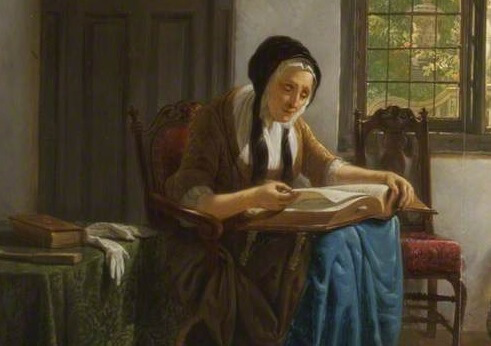
Illustration image: ‘Cottage interior with woman reading a Bible’ (Abraham van Strij, 1753-1826)