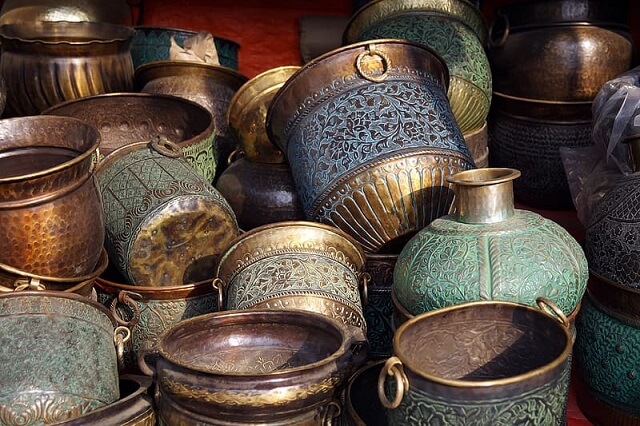
After the victory over the Midianites, Elazar the High Priest explained to the soldiers how to kasher and purify the metal utensils captured in the war:
As far as the gold, silver, copper, iron, tin and lead are concerned: whatever was used over fire must be passed through fire, and it will be clean. However, it must be then purified with the sprinkling water. (Num. 31:22-23)
The Midianite vessels had become defiled in battle, through contact with death. They needed to be purified, by sprinkling over them water mixed with the ashes of the red heifer. This is the standard process of purification, a process that takes a week to complete.
Instant Purity
There exists a second way to purifying utensils — more drastic, but immediate. One simply makes the utensil unusable by boring a large hole in it. Then it is no longer considered a vessel. When the puncture is mended, it is as if a new utensil has been formed, without any residual impurity.
The Talmud (Shabbat 15b) relates that the Hasmonean queen Shlomzion (circa 100 BCE) once held a celebration in honor of her son. Tragically, one of the guests died during the party. As a result, the royal cutlery and dishes became ritually impure. The queen wanted to avoid waiting a week to purify them, so she commanded that the utensils be rendered unusable, and then forged anew.
The rabbis informed the queen, however, that her shortcut was not acceptable. Rabbi Shimon ben Shatach — the queen’s brother — had already ruled that impure utensils that are broken still retain their original impure state after they are fixed.
What led the Sages to make this decree? They were afraid that the ritual of red heifer ashes would fall into disuse if everyone used the faster method of boring a large hole and then fixing the implement.
How to Rectify an Imperfect World
There is, however, a deeper significance to Rabbi Shimon Ben Shatach’s decree. The laws of ritual purity may seem distant from modern life. But upon closer examination, they can have much to teach us — about imperfections in the world, and in each individual.
There are two ways to purify oneself from past follies. The more drastic method is to totally destroy those areas into which evil has rooted itself, and then rebuild from the raw materials left over. This was the method used in the time of Noah, when God purged an utterly corrupt world with the devastating waters of the Flood.
An individual may similarly choose to eliminate deeply rooted personality defects by afflicting his body and soul. With the breakdown of his powers, the evil is also destroyed. Then he can rebuild himself in a moral, just fashion.
Given the rampant level of violence and immorality that have become so entrenched among the human race, the world certainly deserves to have been destroyed. Yet, God in His kindness established another method of purification. The preferred path is to gradually rectify moral defects over time, so that even those unbridled forces may be utilized for good. Only in extreme cases is it necessary to purify through destruction.
The rabbinical decree not to purify utensils by breaking them now takes on a deeper significance. We should not become accustomed to this drastic form of purification, which weakens constructive energies as it purges impurities. It is better to use the slower method of red heifer ashes, thereby allowing the vessel to become pure while retaining all of its original strength.
(Gold from the Land of Israel pp. 282-284. Adapted from Ein Eyah vol. III, pp. 47-48)