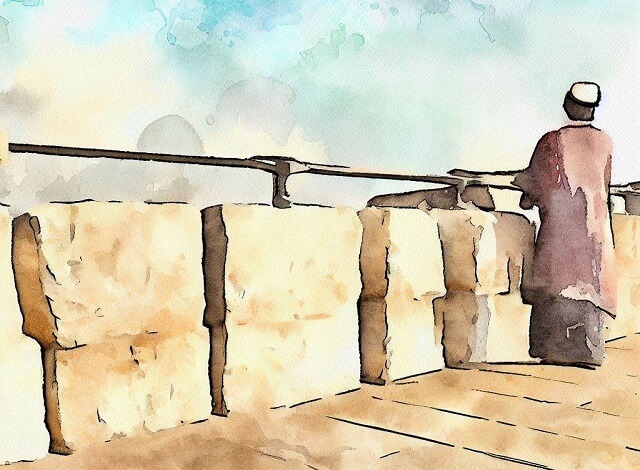
The Torah commands us to set up a guardrail (ma’akeh) to prevent people from falling off the roof. A straightforward mitzvah, if there ever was one. Nonetheless, a deeper look into this mitzvah leads us to a complex philosophical topic. To what extent are events pre-determined, and to what extent do we have free will? To what degree are we responsible for our actions?
‘The One Who Is Falling’
כִּי תִבְנֶה בַּיִת חָדָשׁ וְעָשִׂיתָ מַעֲקֶה לְגַגֶּךָ וְלֹא־תָשִׂים דָּמִים בְּבֵיתֶךָ כִּי־יִפֹּל הַנֹּפֵל מִמֶּנּוּ׃
When you build a new house, you must place a guardrail around your roof. Do not allow a dangerous situation in your house, for the one who is falling could fall from it (Deut. 22:8).
The language in the verse is awkward. What does it mean, “the one who is falling”? Is not the Torah warning against a possible future event? Or has he already started to fall? The Talmud (Shabbat 32a) explains as follows:
This person [who fell] was predestined to fall since the six days of Creation. That is why the verse refers to him as ‘the one who is falling.’ Reward is brought about through a person of merit, while punishment is brought about through a person of guilt.
This Talmudic statement needs to be examined. If the one who fell was supposed to fall anyway, why should I bother with the guardrail? He would have fallen anyway! Where do free will and personal responsibility enter the picture?
Two Systems Governing the Universe
When we witness the phenomenon of cause and effect in the world, we are led to ponder the extent of our personal freedom to act versus underlying, pre-ordained causes. It is important to note that, while free will assumes complete freedom of action, this does not negate the possibility of requisite causes.
We recognize in the economic and political spheres that, despite freedom of personal initiative, there exist overall factors that may neutralize any such attempts at change. For example, the initiative to set up a high-tech company in a backward, third-world country may fail due to lack of infrastructure and skilled labor, political corruption, etc. This is also true in the moral and spiritual realms. We have complete freedom of action and choice, but other underlying factors may negate the actual outcome of our actions. Even when great changes occur, they too may be simply part of the overall divine plan.
In some cases, the discerning eye will detect the effects of actions of free choice, while in others, we see the footprints of pre-ordained causes. In fact, both of these systems — freedom of choice and causality — are tools by which the universe is governed. Together they achieve the overall universal goal, as it says in Isaiah 16:5, “With kindness and truth, the throne will be established.”
Means and Ends
We may divide all activity into means and ends. (In specific instances, however, this distinction may not be obvious, as an action may be a means in one aspect and a goal in another.) Means do not make a permanent impression on the world on their own accord; their significance is due to what they cause. Means relate primarily to the power of free choice. There exist a variety of means that may lead to a particular end; if a goal is not attained through one medium, it will be achieved by another. Ultimate ends, on the other hand, relate to pre-ordained causes.
Now we can understand better the Talmudic principle, “Reward is brought about through those with merit, and punishment through the guilty.” This is the ‘magical’ connection between the two systems, freedom and causality. Through the act of free will by some individual — the means — the appropriate pre-ordained goal, be it reward or punishment, is achieved. In the case of the guardrail, it is the free will of the house-owner, who failed to erect a ma’akeh, that led to the punishment of the one predestined to fall.
(Gold from the Land of Israel, pp. 329-331. Adapted from Ein Eyah vol. III, p. 172)