Tax reporting in the Torah? In a way, yes....
Twice every seven years, in the fourth and seventh years of the Sabbatical cycle, the Jewish farmer must testify that he correctly distributed tithes from his crops. He makes the following declaration, preferably in the Temple itself:
I have removed all the sacred portions from my house. I have given the appropriate ones to the Levite and to the orphan and widow…. I have not violated Your commandments, and have forgotten nothing. (Deut. 26:13)
What exactly is this declaration? The Mishnah explains as follows: “I have not violated Your commandments” — I have been punctilious in all the laws of ma’aserot, such as tithing each type of produce separately. “And have forgotten nothing” — this does not refer to forgetting the mitzvah, but its spiritual context: I did not forget to bless You and mention Your Name when tithing (Ma’aser Sheini 5:11).
What is special about tithing, that only this mitzvah requires such a declaration? Why must we testify that we were punctilious in all its minutiae, and remembered to praise God when distributing ma’aser to the Levite and the poor?
Meticulousness in Mitzvot
There are two aspects to every mitzvah. First, each mitzvah has its own unique function and purpose. In addition, all mitzvot are Divine commands, enabling us to connect to God. They elevate our emotions and character traits, as they resonate with the innermost soul.
How do we show that we are performing a mitzvah as a command from God? By carefully complying with all of its rules. Many mitzvot have a clear and obvious purpose. Were they simply a matter of good citizenship or societal obligations, we would perform them anyway — but without such meticulous observance. Punctilious attention to each detail demonstrates our awareness that we are fulfilling God’s Will.
The mitzvah of tithing serves obvious purposes. Some of the produce goes to feeding the poor and needy (ma’aser ani), while the rest (terumah and ma’aser rishon) supports Torah study and Divine service by providing for the kohanim and Levites, the spiritual leaders of the nation. Especially with regard to mitzvot whose purpose seems obvious, it is important that we recognize that our intellectual powers cannot fully grasp all of their significance and beauty; nor can we truly appreciate the extent of their national and universal benefit throughout the generations.
For mitzvot with revealed reasons such as tithing, it is important to declare that we discharged them meticulously. We should look at mitzvot just as any other creation of God. The commandments have exact parameters, just as the laws of nature operate according to precise rules and processes.
The Privilege of Giving
Why is it so important that we praise God by reciting a blessing when performing the mitzvah of tithing?
An individual who supports others could mistakenly believe that he is the one providing assistance. He may harbor thoughts of his own greatness and importance, leading him to look down on those who receive his help. Such an attitude could undo any spiritual benefit gained from the charitable act. This danger is particularly serious with regard to the kohanim. It is not enough that the nation supports the kohanim’s efforts to disseminate Torah. The kohanim and their spiritual activities need to be beloved and respected by the people. How sorry are those who measure success by the amount of glittering metal they manage to hoard!
In order to prevent this misconception — that those giving are superior to those receiving due to their greater financial means — the benefactors must truly understand that not only are they giving, they are also receiving an immense benefit. By supporting Torah study and the Temple service, they become partners in spiritual endeavors that uplift the entire world.
Therefore, they must not forget to bless God, and express their gratitude for the wonderful privilege to be part of this great enterprise.
(Sapphire from the Land of Israel. Adapted from Ein Eyah vol. II, pp. 406-407)
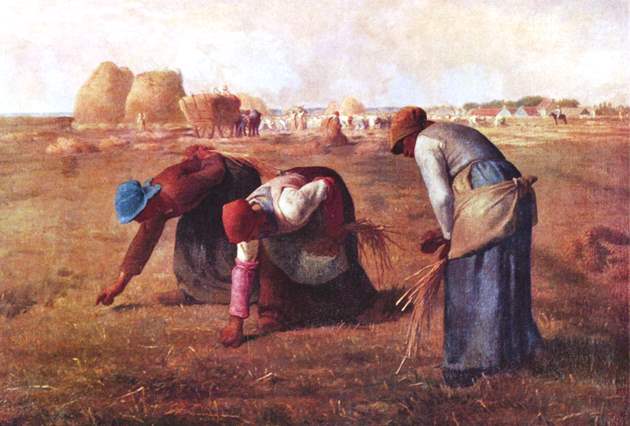
Illustration image: Jean-Francois Millet, The Gleaners (1857)