Spiritual Leap
Lofty teachings cannot be revealed to those who are unsuitable or not ready for them. The enlightenment itself risks becoming debased and twisted when it is associated with sordid individuals. There are, however, exceptional cases, when the current spiritual-moral level of the receiver may be disregarded, and a spiritual ‘leap’ may be accomplished.
God’s revelation to the Israelite slaves in Egypt will forever stand out as an example of such a miraculous “leap.” This is the inner significance of the Passover offering, the korban Pesach, which literally means to “leap” or “skip.” The Jewish people in Egypt had sunken to the lowest levels of degradation and idolatry. In the words of the Midrash, they were on the 49th gate of tum'ah — just one before the lowest state of impurity. For God to be revealed to them during their redemption from Egyptian bondage required a spiritual jump of historic dimensions.
Nonetheless, even the leap of Passover has its limitations.
“This is the law of the Passover offering: no foreigner may eat of it.” (Exodus 12:43)
Who is a “foreigner” who may not partake of the korban Pesach? The Sages taught that this refers not only to Gentiles, but even to Jewish apostates who have abandoned God. These are Jews who have forsaken the Torah’s principles to such an extent that they now fall under the category of “foreigners” (Zevachim 22b).
In other words, even the spiritual leap of the Passover redemption was not boundless in its scope. It could not encompass those Jews who had so completely assimilated into their surrounding idolatrous culture that they lacked even an elementary faith in God.
Rescuing the Light of the First Luchot
This understanding of God’s revelation during the redemption from Egypt sheds light on another historic event.
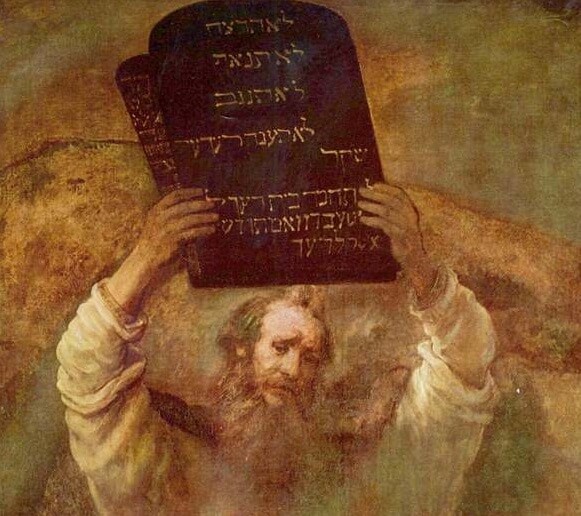
Moses’ act of breaking the luchot habrit (the stone tablets of the Ten Commandments) took tremendous courage. How did Moses dare destroy such a uniquely holy object? How did he know that this was the correct thing to do?
The Talmud suggests that Moses’ act was based on the above-quoted law of the Passover offering. “The Passover offering is just one of the 613 mitzvot, and yet an apostate may not share in it,” he reasoned. “Certainly the Jewish people, after they have sinned by worshiping idols, are unworthy of the Torah in its entirety!” (Shabbat 87a)
In light of our previous comments, Moses’ a priori reasoning becomes even more forceful. What is the inner message of the Passover offering? That God revealed Himself to the Jewish people, despite their spiritual poverty. Nonetheless, even this mitzvah cannot encompass those who reject the fundamental tenets of monotheism. Certainly the Torah as a whole could not be given to the Jewish people in their idolatrous state after worshipping the Golden Calf.
Had Moses in fact given the first set of luchot to the Jewish people, this would have bound the Torah to the state of spiritual impoverishment that enveloped the Jewish people at that time. This would have brought a terrible spiritual danger — to the world, to Israel, and to the Torah itself. Only by hiding that great light, by breaking the physical vessel that bound it to the material world, was Moses able to ensure the spiritual development of the Jewish people and the entire world.
The first luchot, however, were not lost forever. Moses’ act rescued that lofty light, so that it may be revealed at the end of days with a pure and eternal illumination.
(Adapted from Ein Eyah vol. IV, p. 178)
Illustration image: ‘Moses Breaking the Tablets of the Law’ (Rembrandt,1659)