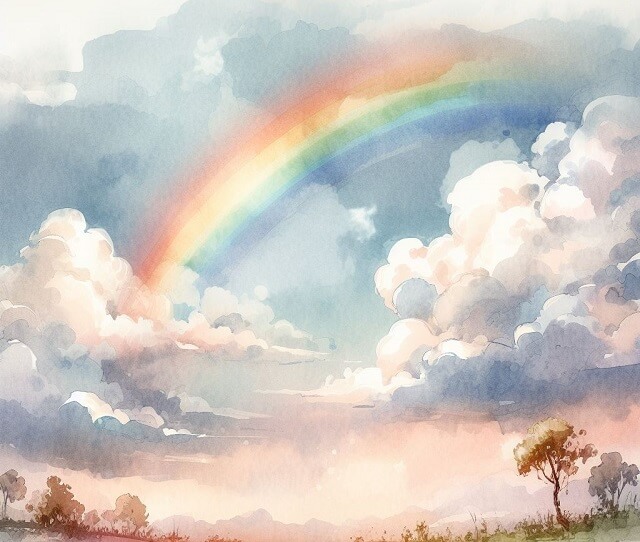
After the Flood, God informed Noah:
I will make My covenant with you, and all flesh will never again be cut off by the waters of a flood.
This is the sign of the covenant that I am placing between Me, you, and every living creature that is with you, for all generations: I have set My rainbow in the clouds... The rainbow will be in the clouds, and I will see it to recall the eternal covenant. (Gen. 9:11-16)
In what way does the rainbow symbolize God’s covenant, never again to destroy the world by a flood? Why does the Torah emphasize that this rainbow is “in the clouds”? And most importantly, what is the significance of this Divine promise never again to flood the world? Does this imply that the Flood was unjust? Or did God change His expectations for the world?
The rainbow is not just a natural phenomenon caused by the refraction of light. The “rainbow in the clouds” represents a paradigm shift in humanity’s spiritual development.
Pre-Flood Morality
Before the devastation of the Flood, the world was different than the world we know; it was younger and more vibrant. Its physical aspects were much stronger, and people lived longer lives. Just as the body was more robust, the intellect was also very powerful. People were expected to utilize their intellectual powers as a guide for living in a sensible, moral fashion. The truth alone should have been a sufficient guide for a strong-willed individual. Ideally, awareness of God’s presence should be enough to enlighten and direct one’s actions. This was the potential of the pristine world of the Garden of Eden.
Rampant violence and immorality in Noah’s generation, however, demonstrated that humanity fell abysmally short of its moral and spiritual potential. After the Flood, God fundamentally changed the nature of ethical guidance for the human soul. The sign that God showed Noah, the “rainbow in the clouds,” is a metaphor for this change.
Greater Moral Guidance
The rainbow represents divine enlightenment, a refraction of God’s light, as it penetrates into our physical world. Why does the Torah emphasize that the rainbow is “in the clouds”? Clouds represent our emotional and physical aspects, just as clouds are heavy and dark (the Hebrew word geshem means both ‘rain’ and ‘physical matter'). The covenant of the “rainbow in the clouds” indicates that the Divine enlightenment (the rainbow) now extended from the realm of the intellect, where it existed before the Flood, to the emotional and physical spheres (the clouds). God’s rainbow of light now also penetrated the thick clouds of the material world.
How was this accomplished? The Divine light became ‘clothed’ in a more physical form – concrete mitzvot. God gave to Noah the first and most basic moral code: the seven laws of the Noahide code. These commandments served to bridge the divide between intellect and deed, between the metaphysical and the physical.
We can now understand God’s promise never again to flood the world. After the Flood, total destruction of mankind became unnecessary, as the very nature of human ethical conduct was altered. Our inner spiritual life became more tightly connected to our external physical actions. As a result, the need for such a vast destruction of life, as occurred in the Flood, would not be repeated. Of course, individuals — and even nations — may still choose to sink to the level of savages and barbarians. But the degree of immorality will never again reach the scope of Noah’s generation, where only a single family deserved to be saved.
(Gold from the Land of Israel pp. 34-36. Adapted from Ein Eyah vol. II, pp. 318-319)