Moses’ father-in-law Jethro rejoiced when he heard of all that God had done for the Israelites:
Blessed be God Who rescued you from hand of Egypt and from the hand of Pharaoh, Who liberated the people from Egypt’s power. Now I know that God is the greatest of all deities: the very thing they plotted came on them! (Ex. 18:10-11)
The Sages learned from Jethro’s blessing that when one sees a place where a miracle occurred for the Jewish people, one should recite the blessing שֶׁעָשָׂה נִסִּים לַאֲבוֹתֵינוּ בַּמָּקוֹם הַזֶּה — “Who made miracles for our fathers in this place“ (Berakhot 54a).
This statement, however, is difficult to understand in light of the fact that Jethro did not say this blessing when visiting the Red Sea, but when he met Moses and the Israelites in the Sinai desert. How could Jethro serve as an example for this brachah, which is only recited when seeing the location where a miracle took place?
Appreciating all Aspects
We need to examine the concept of reciting a blessing over a miracle. Consider two different situations. In case A, a person was headed for the hospital and allowed a neighbor who was not feeling well to come along. The sick neighbor will be thankful for the assistance, but his gratefulness will be tempered by the fact that his benefactor was planning to go there anyway.
In case B, the benefactor, realizing that his neighbor was ill and needed to see a doctor, made a special trip to take him to the hospital. Clearly, the sick neighbor will feel much more thankful in this situation, where the assistance was rendered expressly for him.
If we consider the nature of a miracle, we will realize that it is similar to case B. When we bless God over a miraculous deliverance, we feel completely indebted and thankful to God, as this Divine intervention took place explicitly to help us.
But there is an additional aspect of Divine deliverance which should heighten our sense of gratitude. When an act comes directly from God, not only is the overall goal for the ultimate good, but also all the ramifications and side effects that result from the miracle. We should be appreciative not only for the actual deliverance, but also for any accompanying details. This even includes the location of the miracle, which at some point in time benefited (or will benefit) from the miracle.[1]
The Sages learned this from Jethro: that a blessing over a miracle should include recognition of the benefits gained from the miracle’s accompanying details.
Besides thanking God for the overall rescue (“Who liberated the people from Egypt’s power”), Jethro also mentioned the details of that rescue: that they were saved from the hands of the Egyptian people and from the hands of Pharaoh.[2]
Furthermore, Jethro called attention to the poetic justice — middah kneged middah — in the way that the Egyptians were punished. “The very thing they plotted came upon them.” The Egyptians drowned Jewish babies, so they were punished by drowning in the Red Sea. Here was an additional detail that reflected the ultimate justice of the miracle in all of its aspects.
(Sapphire from the Land of Israel. Adapted from Ein Eyah vol. II, pp. 243-244)
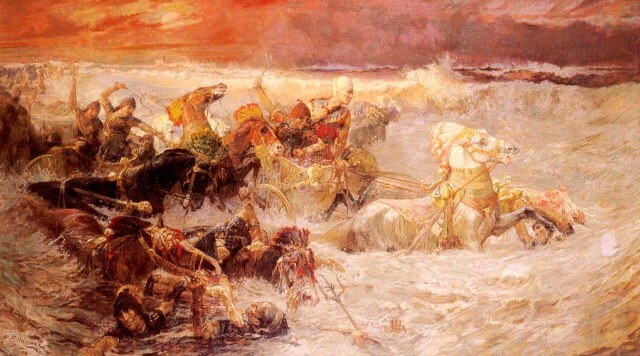
Image: "Pharaoh's Army Engulfed by the Red Sea" by Frederick Arthur Bridgman (1900)
Cf. the explanation given by Rabbi Nissim of Gerona (1320-1376) for the ancient custom of praying at the graves of great scholars and prophets. “Prayer at these locations is more desirable, since bodies that once experienced the Divine shefa [prophetic influence] are buried there.” Sparks of holiness can still be found at their gravesites, “since their bones served as vessels for the Divine shefa ” (Drashot HaRan, Drush 8). ↩︎
For one can suffer at the hands of a cruel people, even if the king is kind; and one can suffer at the hands of an evil king, even if the people are sympathetic. In Egypt, the Israelites were the victims of cruelty on the part of the people and the king. ↩︎