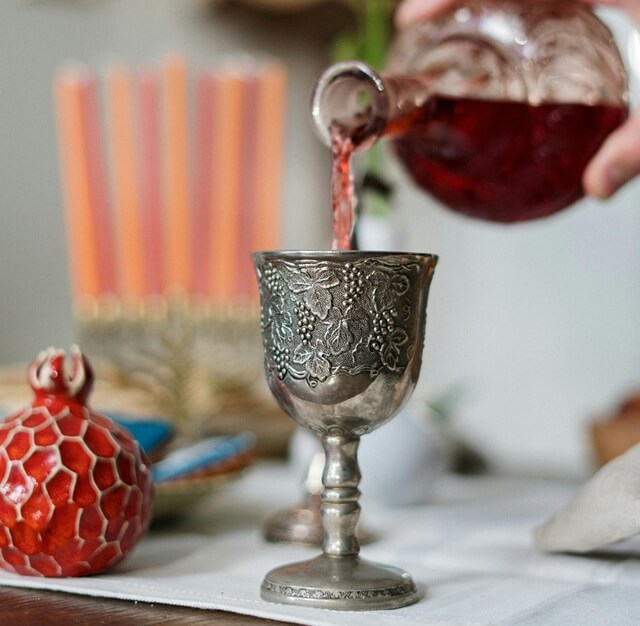
The centerpiece of a Jewish ceremony is often a glass of wine. Weddings, circumcisions, kiddush on the Sabbath — all make use of wine, a symbol of joy.
The Talmud (Berakhot 51a) teaches that one should fill this cup of wine to the brim: “Whoever says the blessing over a full cup is given a boundless inheritance” and “is privileged to inherit two worlds, this world and the next.” The Sages derived this reward of a “boundless inheritance” from Moses’ blessing to the tribe of Naphtali before his death:
He shall be filled with God’s blessing, inheriting [land] to the west and to the south (Deut. 33:23).
Why is it important to fill the ceremonial glass to the brim? Why should this act grant us boundless riches and an inheritance in this world and the next?
The Pursuit of Riches
One might think that if we sincerely desire to live life according to our true spiritual goals, then we should make do with only our barest needs. We should distance ourselves as much as possible from the distracting pursuit of luxuries.
And yet, the desire for an expansive lifestyle is ingrained in human nature. It is natural to delight in greater wealth, nicer homes, and fancier cars. There must be some deeper purpose to this innate human tendency.
In fact, the pursuit of riches is only a negative trait when its sole objective is self-gratification. Wealth and material possessions serve no purpose if there are acquired only for our own personal benefit. But if we utilize our energy and joy in life for that which is good and proper, than it is unnecessary to restrict these natural tendencies. On the contrary, generous and kind-hearted individuals can accomplish many more good deeds when they are blessed with wealth.
A full cup of wine represents an abundance of riches. The Sages praised filling a wine-glass to the brim, but on condition that the glass is a kos shel berachah, a cup used for mitzvot and good deeds. With such a “cup of blessing,” it is proper to pursue a life of wealth, as we recognize that these material blessings are not a goal but a vessel, a tool to perform mitzvot and help others, both physically and spiritually.
Boundless Inheritance
Those who pursue riches only for their own physical pleasure have set themselves very limited goals. How much joy can all the pleasures of the universe generate when they are confined to one individual? But for those who seek financial success in order to help others, there is no end to the benefit their wealth can provide. Therefore, the Sages taught that such individuals are blessed with a “boundless inheritance.”
In addition, if we recognize that God is the source for all blessings, then being showered with material wealth helps us develop the important traits of thankfulness and gratitude. Our resolve to serve God and help others is strengthened, and we become loyal emissaries of God in spreading kindness in the world.
Inheriting Both Worlds
For most people, there is a clear dichotomy between physical and spiritual pleasures. This world and the next are separate, even competing, realms.
But if our love for this world is based upon the good that we can do for others, then the pursuit of material riches is also a spiritual pursuit, and there is no longer any contradiction between the love of this world and the World to Come. Life in this world becomes a spiritual life, filled with the pure ideals of loving-kindness and generosity. This is the “inheritance of two worlds” that the Sages ascribed to those who fill their mitzvah wine-glass to the brim.
(Gold from the Land of Israel. Adapted from Ein Eyah vol. II, pp. 225-226)