In an enigmatic passage after the death of Rachel, the Torah harshly condemns Reuben: “Reuben went and lay down with Bilhah, his father’s concubine” (Gen. 35:22).
According to Talmudic tradition, what actually transpired was far less shocking. Reuben was in fact protecting his mother’s honor and place in the family. When Rachel was alive, Jacob kept his bed in Rachel’s tent. After she died, Jacob moved his bed to the tent of Rachel’s handmaid, Bilhah.
But Reuben, Leah’s first-born, was upset. Perhaps his aunt Rachel could displace his mother as Jacob’s primary wife; after all, Rachel had been the woman that Jacob intended to marry. But surely Rachel’s handmaid held a lower position in the household than his mother Leah! So Reuben removed his father’s bed from Bilhah’s tent and placed it in the tent of his own mother, Leah.
The Talmud in Shabbat 55b explains that we should not think that Reuben literally slept with Bilhah; rather, he “disturbed Bilhah’s sleeping arrangements.” The Sages could not accept the idea that one of Jacob’s sons was guilty of incest. Furthermore, the verse immediately continues, “Jacob had twelve sons.” Surely we know this already! The Torah is emphasizing that, even after this disruption in Jacob’s household, all twelve were still sons of the tzaddik Jacob; all twelve were equally righteous.
Still, we need to understand. If the incident in Jacob’s house occurred the way the Sages described, why did the Torah not write it that way? Why does the Torah ‘mislead’ us into thinking that Reuben had performed such a serious offense?
Two Perspectives on One Event
Rav Kook wrote that the Torah describes events in a particular way so that they will make a certain desired impression. Every detail in the Torah is carefully measured, so that the narrative will suitably affect us.
Sometimes a story, when written in a straightforward fashion, cannot be properly appreciated by those reading it, especially if they are greatly removed from the incident in time and place. From afar, we may not be properly sensitive to the moral outrage that took place. In such instances, divine wisdom dictates the precise fashion with which to clothe the story, in order that it should make the appropriate impression on the reader.
Together, the two Torahs, the Oral and the Written, paint a complete picture of what occurred. The Written Torah gives a simpler account, providing the emotional impact to which we are accustomed from our youth. The Oral Torah adds to the written account a more insightful understanding that is acquired through careful examination.
The activities of the Patriarchs deeply influenced, and continue to influence, the Jewish people. The spirit of Jacob’s house lives with us to this day; the light of his family will forever illuminate our hearts. Any dimming of that light, any inner strife or moral imperfection, will also be felt by us. In fact, even more so: any minor eclipse of light from that time will reach us from afar as a serious and deeply disturbing darkness.
For us, the true extent of Reuben’s offense — upsetting the delicate balance in his father’s household and eroding Jacob’s authority in his own home — is as if Reuben had actually committed incest with Bilhah. The literal account of the written Torah corresponds to our natural feelings of hurt and indignation.
But if we wish to accurately evaluate this offense in terms of Reuben’s moral level, we must return to the Talmudic version of this event. Here the Midrashic insight reveals the event as it actually occurred: Reuben disturbed the sleeping arrangements in his father’s house, in order to protect his mother’s honor.
(Gold from the Land of Israel, pp. 75-77. Adapted from Ein Eyah vol. IV, pp. 43-44)
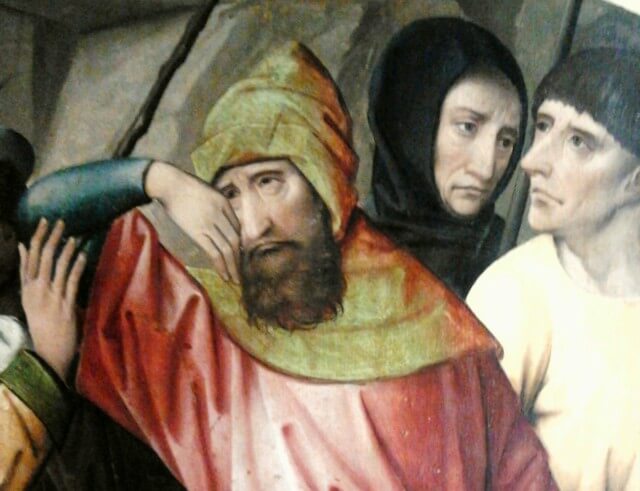
Illustration image: Reuben and his brothers (Colijn de Coter, 1450-1455)