When the fourth-century scholar Rav Sheshet fasted, he would add the following request to his Amidah (Standing) prayer:
Master of the Universe! You know that when the Temple stood, a person who sinned would bring a sacrifice. Although only the fats and blood would be offered on the altar, the person would be granted atonement.
Now I have fasted, and my fat and my blood have diminished. May it be Your Will that the decrease in my fat and my blood should be considered as if I offered them on the altar, and my offering was accepted. (Berakhot 17a)
Rav Sheshet’s prayer is inspiring, but it makes one wonder: Why should one go to the trouble of bringing a sacrifice if the same atonement may be achieved through fasting?
His prayer draws our attention to a second issue. Why were only the fats and blood of sin sacrifices (chatat and asham) offered on the altar?
Two Types of Sin
Regarding the offering of fats and blood, Rav Kook explained that there are two major inducements to sin. Some sins are the result of overindulgence in sensual pleasures and excessive luxuries. These wrongdoings are appropriately atoned by offering the fats.
The second category of transgressions is motivated by actual need: hunger and poverty. Great pressures can tempt one to lie, steal, even murder. The corresponding atonement for these sins is through the blood of the offering.
The Disadvantage of Fasting
By fasting, we can attain atonement in a way similar to the sacrifice of fats and blood in the Temple service. However, there is an important distinction between fasts and sacrifices. Offering a sacrifice in the holy Temple instilled the powerful message that it should really be the offender’s blood spilled and body burned, were it not for God’s kindness in accepting a substitute and a ransom. This visceral experience was a humbling encounter, subduing one’s negative traits and desires.
Fasting, on the other hand, weakens all forces of the body. Just as chemotherapy treatment poisons other parts of the body as it fights the cancer, so too, fasting saps both our positive and negative energies. Fasting has the unwanted side effect of weakening our strength and energy to help others, perform mitzvot, and study Torah.
Therefore, Rav Sheshet added a special prayer when he fasted. He prayed that his fasting would achieve the same atonement as an offering in the Temple, without the undesirable effect of sapping positive energies.
(Gold from the Land of Israel, pp. 177-178. Adapted from Ein Eyah vol. I, p. 82)
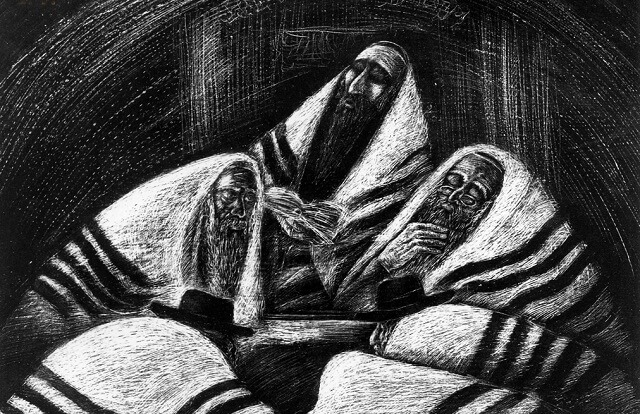
Illustration image: ‘Jews at Prayer’ (Bedřich Fritta, Theresienstadt, 1941-1944)