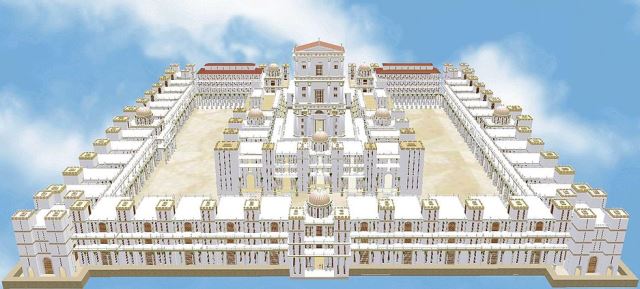
What will the rebuilt Temple be like? Will we really offer animal sacrifices once again?
Protecting Animals
Some people object to the idea of sacrifices out of concern for the welfare of animals. However, this objection contains a measure of hypocrisy. Why should compassion for animals only be expressed with regard to humanity’s spiritual needs? If our opposition to animal slaughter is based not on weakness of character, but on recognition of the issue’s fundamental morality, then our first step should be to outlaw the killing of animals for food, clothing, and other material benefits.
In the world’s present state, the human race is weak, both physically and morally. The hour to protect animal life has not yet arrived. We still need to slaughter animals for our physical needs, and human morality requires that we maintain clear boundaries to distinguish between the relative value of human and animal life.
At this point in time, to advocate the protection of animals in our service of God is disingenuous. Is it moral to permit cruelty towards animals for our physical needs, yet forbid their use for our spiritual service, in sincere recognition and gratitude for God’s kindness? If our dedication and love for God can be expressed — at its highest level — with our willingness to surrender our own lives and die al kiddush Hashem, sanctifying God’s name, then certainly we should be willing to forgo the life of animals for this sublime goal.
The Return of Prophecy
Currently, however, we are not ready for an immediate restoration of the sacrificial service. Only with the return of prophecy will it be possible to restore the Temple order. In a letter penned in 1919, Rav Kook explained:
With regard to sacrifices, it is more correct to believe that all aspects will be restored to their place. ... We should not be overly troubled by the views of European culture. In the future, God’s word to His people will elevate all the foundations of culture to a level above that attainable by human reason.
It is inappropriate to think that sacrifices only reflect the primitive idea of a worship of flesh. This service possesses a holy inner nature that cannot be revealed in its beauty without the illumination of God’s light to His people [the return of prophecy] and a renewal of holiness to Israel. And this will be recognized by all peoples. But I agree with you that we should not approach the practical aspects of sacrifices before the advent of revealed divine inspiration in Israel. (Iggerot HaRe’iyah vol. IV p. 24)
The Future World
In the writings of the Kabbalists, we find a remarkable description of how the universe will look in the future, a world vastly changed from our current reality. All aspects of the universe will be elevated. Even the animals in that future era will be different; they will advance to the level of people nowadays (Sha’ar Hamitzvot of the Ari z"l). Obviously, no sacrifice could be offered from such humanlike animals. At that time, there will no longer be strife and conflict between the species. Human beings will no longer need to take the lives of animals for their physical, moral, and spiritual needs.
It is about this distant time that the Midrash makes the startling prediction, “All sacrifices will be annulled in the future.”[1] The prophet Malachi similarly foretold of a lofty world in which the Temple service will only consist of grain offerings, in place of the animal sacrifices of old:
Then the grain-offering of Judah and Jerusalem will be pleasing to God as in the days of old, and as in ancient years. (Malachi 3:4)
Hints to the Future
Even in the current reality, we may feel uncomfortable about killing animals. This does not mean that the time for full animal rights has already arrived. Rather, these feelings come from a hidden anticipation of the future that is already ingrained in our souls, like many other spiritual aspirations.
Hints of these future changes may be found in the text of the Torah itself. Thus, it says that offerings are slaughtered on the northern side of the altar. Why this side? The north traditionally represents that which is incomplete and lacking, as it is written, “Out of the north, the evil shall break forth” (Jeremiah 1:14). In other words, the need to slaughter animals is a temporary concession to life in an incomplete world.
Furthermore, the Torah stipulates that sacrifices must be slaughtered לִרְצֹנוֹ — “willingly” (Lev. 1:3). The Temple service must correspond to our needs and wants. As the Talmud in Erchin 21a explains, one must be able to say, “I want to bring this offering.” When the slaughter of animals is no longer generally acceptable to society, this condition will not be fulfilled.
Finally, the Torah describes a person offering an animal sacrifice as adam (Lev. 1:2). This word indicates our current state of moral decline, a result of the unresolved sin of Adam, the first man. An individual offering a grain offering, on the other hand, is called nefesh, or soul (Lev. 2:1). The word nefesh implies a deeper, more essential level of humanity, independent of any temporary failings.
(Gold from the Land of Israel pp. 173-176. Adapted from Otzarot HaRe’iyah, vol. II, pp. 101-103; Olat Re’iyah vol. I, p. 292)
Tanhuma Emor 14, Vayikra Rabbah 9:7. The Midrash writes, however, that the Todah (Thanksgiving) offering will always be brought. Perhaps Rav Kook believed that the Todah offering in the future will only consist of the 40 loaves of bread, as this is its unique and defining feature, unlike other offerings that stress the animal component. ↩︎