We all have limited amounts of time and energy and must learn how to apportion these resources wisely. In particular, we need to find a balance between activities that are directed inwardly, for our own personal development, and those directed outwardly, for the benefit of others. As Hillel taught, “If I am not for myself, who will be for me? And if I am only for myself, then what am I?” (Avot 1:14). Both areas are crucial. The difficulty lies in deciding how much of our time and resources should be dedicated to inner growth, and how much for reaching out to others.
The nation as a whole also needs to juggle these two competing spheres. The search for the correct balance was played out in the dispute between Joseph and his brothers. Their struggle corresponded to two different paths within the Jewish people — one stressing the nation’s own spiritual development, and the other emphasizing Israel’s universal responsibility and influence.
Eidut and Torah
The Jewish people are crowned with two qualities, Eidut (testimony) and Torah, as it says: “[God] established testimony in Jacob; He set down Torah in Israel” (Ps. 78:5). What are these two qualities?
The essence of Eidut is to accurately report facts as they occurred. Nothing may be added or altered when giving testimony. Torah study, on the other hand, involves chiddush — creative and innovative thought.
This dichotomy of Eidut and Torah is the root of the conflict between Jacob’s sons. Joseph stressed the concept of Eidut, as it says, “a testimony (eidut) for Joseph” (Ps. 81:6). The aspect of Eidut reflects Joseph’s desire to interact with the nations and expose them to the authentic message of monotheism and morality.
On the other hand, the other brothers — and especially Judah, their leader — emphasized the Torah and the special holiness of the Jewish people. They sought to develop and cultivate the unique heritage of Israel. Thus it was Judah whom Jacob picked to establish an academy of Torah study in Goshen. Furthermore, the Midrash credits Judah with burning the wagons that Pharaoh sent to bring Jacob’s family to Egypt. Judah ordered that the wagons be destroyed when he saw that they were engraved with idolatrous symbols (Breishit Rabbah 94:3). This act, introducing the law of destroying idols with fire [later codified in Deut. 7:25], demonstrated Judah’s focus on the aspects of purity and innovation in Torah.
The Message of Shema
Joseph and Judah, and their paths of Eidut and Torah, were united when Jacob brought his family down to Joseph in Egypt. The Sages noted a peculiar incident that took place during the family reunion. The Torah relates that Joseph cried on his father’s neck, but is silent regarding Jacob’s actions at this emotional meeting. What was Jacob doing? According to the Midrash, he was busy reciting the Shema. What was the significance of the Shema at that particular time?
The Shema’s message is, of course, one of unity. “Listen, Israel: God is our Lord; God is one” (Deut. 6:4). These two phrases refer to two levels (or stages) of God’s unity in the world. The first level is “God is our Lord.” This is God’s unity as it is currently revealed in the world, a world created according to the blueprint of Torah, and through which we can recognize the greatness of the Creator. The second, higher level is “God is one.” This is God’s unity as it will be revealed in the future, a unity that will encompass the entire universe. “After all has ceased to be, the One revered will reign alone” (from the Adon Olam hymn).
Judah represents the first level of God’s unity, a unity manifested through the Torah and the special role of the Jewish people. Joseph, on the other hand, sought to sanctify God’s Name among the nations and bring knowledge of one Creator to the entire world. He represents the second level, the universal unity of God. Jacob’s recitation of the Shema thus encapsulated the combined visions of both Judah and Joseph.
The Scales of the Leviathan
The two paths within Jacob’s family — Judah’s path of particularity and Joseph’s path of universality — split when Joseph was sold as a slave. The brothers’ reconciliation and the unification of these two paths took place in Vayigash, when Judah drew near to his brother Joseph (Gen. 44:18).
The Midrash (Breishit Rabbah 93:2) chose a curious verse to describe the coming together of Joseph and his brothers. The word vayigash (“and he drew near”) also appears in Job’s description of the scales of the giant Leviathan: “One is so near (yig’shu) to the other, that no air can enter between them” (Job 41:8). What do the Leviathan’s scales have to do with the reunification of Jacob’s family?
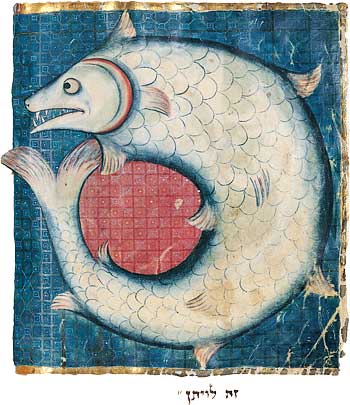
According to the Sages, this fearsome sea creature belongs in a category of its own. All living creatures have both males and females, except the Leviathan (Baba Batra 74b). In other words, while all other creatures reflect a quality of duality and fracture that exists in our imperfect world, the Leviathan retains something of the universe’s original unity. Thus the Talmud describes the Leviathan as being akalton — twisting around and encompassing the entire world (Rashi ad loc). The Zohar (2:179a) teaches that “its tail is placed in its mouth.” In other words, this wondrous creature has neither beginning nor end. Undetected, it surrounds and unites the entire world. This hidden unity will be revealed in the future, when the righteous tzaddikim will feast on the Leviathan (Baba Batra 74b).
The future will reveal the underlying oneness of the universe, the ideal balance of Torah and Eidut, of Judah and Joseph, of our inwardly and outwardly directed efforts, of the particular and the universal. The two paths will be united like the scales of the Leviathan, magnificently arranged “one so near to the other that no air can enter between them.”
(Sapphire from the Land of Israel. Adapted from Shemuot HaRe’iyah, vol. 10 (1930))
Illustration image: Leviathan, North French Hebrew Miscellany manuscript (1278-1298)