Fourth-century scholar Rabbi Zeira once found his teacher Rabbi Yehudah in an unusually good mood. Realizing that it was a propitious time to ask whatever he wanted, Rabbi Zeira posed the following question:
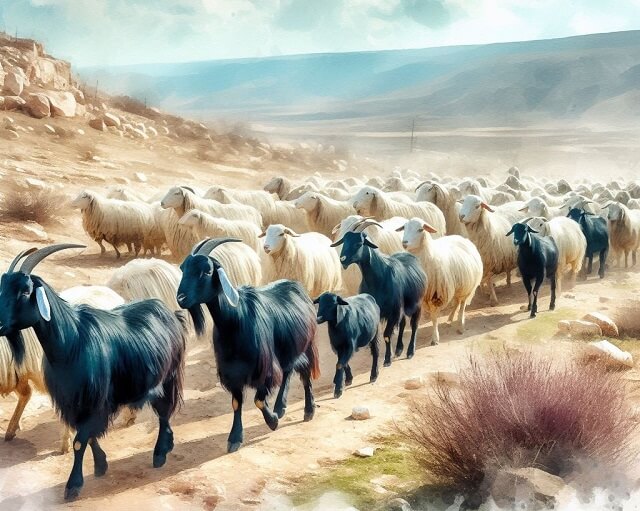
Why is it that the goats always stride in front of the herd, to be followed by the sheep?
Perhaps the last thing we would expect Rabbi Zeira to ask would be a mundane fact of animal husbandry. Rabbi Yehudah, however, was not fazed. Good-humoredly, he explained that this phenomenon reflects the order of creation.
It is like the creation of the universe: first there was darkness [the goats, who are usually black], and afterward light [the white sheep] (Shabbat 77b).
A treasure-trove of wisdom had opened up for Rabbi Zeira — he had the opportunity to inquire into the deepest secrets of the universe! — and instead, he quizzed his master about goats and sheep?
The Shepherd-Philosopher
In fact, Rabbi Zeira’s query was not so out of line. The great leaders of the Jewish people in ancient times were shepherds. As Joseph’s brothers informed Pharaoh, “Like our fathers before us, we are shepherds” (Gen. 47:3). Moses and David also worked in this profession. There must be a reason that our ancestors chose to herd goats and sheep.
Shepherding is a lifestyle that allows for reflection and inner contemplation. The labor is not intensive. Unlike farming, one does not need to immerse all of one’s energies in physical matters. At the same time, the shepherd remains in constant contact with the real world. His reflections are sound, based on life experiences. He does not delve in artificial philosophies detached from reality. For this reason, our forefathers, the great thinkers of their time, worked as shepherds.
Development of Thought
Rabbi Zeira’s observation about flocks makes a connection between the external focus of the shepherd — his goats and sheep — and his internal focus — his thoughts and ideas.
Ideas first come to us as vague thoughts, obscured by the blurry mist of our imagination. Hidden in the murky fog, however, lies a great treasure. Over time, we refine and clarify our thoughts, and from the shrouded darkness comes forth light and wisdom.
The pattern of traveling animals corresponds to the development of thought in the shepherd’s mind. The image of dark goats breaking out in front of the white sheep is an apt metaphor for the inspired but hazy notions that surge forth in our thoughts. These streaks of insight are followed by a flock of clarified ideas that have been examined by our faculties of reason. In this way, we develop the reasoned concepts that form the basis for our intellectual and spiritual life.
The Need for Opacity
As Rabbi Yehudah pointed out, this order is inherent to the nature of the world. The light in the universe was created out of the darkness. This phenomenon is also true on a personal level. We cannot completely dismiss the illusory aspects of our minds, for they inspire us to originality of thought. Our imagination dominates our thought processes; it is only through its fuzzy insights that we can arrive at the path of enlightened wisdom.
(Gold from the Land of Israel. Adapted from Ein Eyah vol. IV, pp. 144-145)