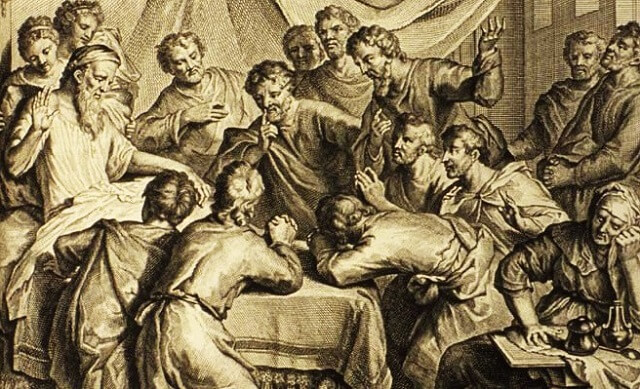
Jacob called for his sons. He said: ‘Gather together, and I will tell you what will happen at the End of Days.’ (Gen. 49:1)
In fact, Jacob never revealed to his sons when the final redemption would take place. According to the Midrash, this secret — the time of redemption — was hidden from Jacob. The Midrash uses the following parable to explain what transpired between Jacob and his sons at Jacob’s death bed.
The Parable of the Devoted Servant
This is like the case of a devoted servant whom the king trusted with all that he possessed. When the servant realized his end was near, he assembled his sons in order to set them free and inform them where their will and deed were located.
The king, however, discovered [this plan] and stood over his servant. When the servant saw the king, he backtracked from what he had planned to tell his sons. He began to entreat his sons, ‘Please, remain servants of the king! Honor him just as I have honored him all of my days.’
So, too, Jacob gathered his sons to reveal to them the End of Days. But the Holy One revealed Himself to Jacob. ‘You summoned your sons, but not Me?'... When Jacob saw God, he began to entreat his sons, ‘Please, honor the Holy One just as my fathers and I have honored Him.’
The Holy One then informed [Jacob]: ‘It honors God to conceal the matter’ (Proverbs 25:2). This attribute does not belong to you. (Midrash Tanchuma VaYechi 8)
This Midrash raises many questions. Why did Jacob want to reveal to his sons when the final exile would end? Why was he prevented from doing so? Also, there are discrepancies between the parable and the referent. It was God who concealed the end of days from Jacob; thus in the parable, it should have been the king who hid the deed from the servant, not the servant who hid the deed from his sons. Furthermore, the servant wanted his sons to be free — would Jacob have wanted his sons to abandon the yoke of Heaven? And why did God reprimand Jacob for not calling Him?
The Reason for the Lengthy Exile
We first need to examine why the exile has lasted so long. It is written that the people of Israel “were punished twice for all their sins” (Isaiah 40:2). How could God, the compassionate Father, punish the Jewish people more severely than they deserved to be punished?
The key to understanding this matter lies in the verse:
I have only known you from all of the families of the earth. Therefore, I visit upon you all of your iniquities. (Amos 3:2)
If the Jewish people were like all other peoples, then the destruction of the Temple would have sufficed to atone for their sins. However, the Jewish people are destined to acquire a true, intimate love of God, permanently fixed in their hearts, as indicated by the phrase “I have only known you,” which implies a unique relationship between God and the Jewish people. In order to achieve this level of unfailing, constant love, they need to undergo an intensive purification to purge all moral and spiritual failings. If not corrected, these dormant faults could be reawakened and induce moral relapses in future generations.
For this reason, the Sages wrote that the people of Israel sinned doubly, were punished doubly, and will be consoled doubly (Pesikta deRav Kahana, Nachamu). Their sin was twofold: besides the gravity of the sin itself, it led to their estrangement from God. They were also punished doubly: in order to cleanse them from the sin and to purify their hearts to love God. And they will also be consoled doubly: not only will their transgressions be forgiven, they will also merit a special closeness to God.
Calculating the End of Days
The second issue that must be clarified is: is it possible to know when the End of Days will come? The Sages interpreted the verse, “A day of retribution is in My heart” (Isaiah 63:4) as follows: “to My heart I have revealed it, but not to My limbs” (Sanhedrin 97a). The term “My limbs” is a metaphor for the angels. How could Jacob have access to information which was hidden even from the angels?
Theoretically, if we were to know the spiritual level the Jewish people need to attain, the errors that future generations will commit, and the time needed to rectify those errors, then we would be able to calculate when the End of Days will occur. However, even this complex calculation is not so straightforward. Perhaps God will not wait until the Jewish people are worthy of redemption based on their own merits? Perhaps God will not delay the redemption until their sins have been fully expiated through exile, but will hasten the end, elevating Israel even before the people have properly prepared themselves to be redeemed?
In fact, this is precisely how Daniel interpreted King Nebuchadnezzar’s dream, a dream foretelling “what will be at the End of Days.” In the dream, Nebuchadnezzar saw that “a stone, broken off not by [human] hands, struck the statue” (Daniel 2:34). This great statue, wrought from four different metals, symbolized the four great empires — commonly understood to be Babylon, Persia, Greece, and Rome — and the corresponding exiles of the Jewish people. The stone, the Divine instrument for destroying the statue and terminating the exile, was “broken off not by human hands,” indicating that the final redemption will not be achieved solely through the efforts of the Jewish people. God desires that Israel will work toward rectifying its sins and moral deficiencies; but ultimately, it will be granted eternal spiritual greatness by God Himself (See Zohar, Pekudei 240).
Spiritual Growth versus Submission
The righteous who walk before God always try to attain spiritual perfection on their own, without ‘burdening’ Heaven and expecting Divine assistance. Jacob wanted his family to acquire the final objective of constant love for God through their own efforts. By revealing the End of Days to them, Jacob intended to indicate the objective that they should strive for, so that they could attain this level through their own actions.
God, however, had different plans. Humanity was given free will so that they should not need to rely on nehama dekisufa, the “bread of shame.” The necessity to labor and make correct choices in life gives us the satisfaction of earning our reward. Yet there is a drawback to attaining perfection through our own efforts. While the ultimate goal is to attain love of God, we also need to feel a sense of awe and submission before God. In truth, for all of our remarkable potential, we do not deserve to be called “God’s servants.” The Midrash teaches that God held Mount Sinai over the Israelites like a bucket, forcing them to accept the Torah (Shabbat 88a). This demonstrated that the Jewish people must also acknowledge their subservience to God.
Similarly, in the end of days, God will not wait until the people of Israel have perfected themselves, for then they would only have the merit of loving God, and would lack the necessary awe and servitude to Him. God will redeem the Jewish people before they are ready; the redemption will arrive like “a stone that was not broken off by [our own] hands.” It is impossible to calculate the hour of redemption, for it will not occur when the Jewish people are ready, but when God deems it time. Thus Isaiah’s prophecy indicates that the date is only revealed to “My heart” — i.e., only God knows.
Explaining the Parable
Now we may understand the parable. The king’s servant wanted to free his sons from subservience to the king so that they would be able to serve the king purely out of love. When the king stood above him, however, the servant recognized that the majesty of the king is so great, that the highest level is in fact to be the king’s servant. That is why God rebuked Jacob when he summoned his sons without Him. God was questioning Jacob: Do you want the redemption to be achieved only through your own efforts? Do you want it to be exclusively based on the quality of love for God?
Complete adherence to God’s will, however, could only take place after the Torah was given at Sinai. Thus the Midrash concludes with God’s rejoinder to Jacob: “This matter is not for you.” True subservience to God will only be possible after the revelation of the Torah and its mitzvot.
When the faithful servant saw the king in all his majesty standing over him, he backtracked from his original plan of freeing his sons. Similarly, after God revealed Himself, Jacob recognized God’s infinitely exalted nature. He realized that, even in the End of Days, the true goal is to combine love with submission and awe. Therefore, Jacob abandoned his plan to reveal the level of pure love of God that the Jewish people need to attain in the End of Days. Instead, Jacob admonished his sons to honor and fear God, just as he and his fathers had done.
(Sapphire from the Land of Israel. Adapted from Midbar Shur, pp. 273-280)
Illustration image: ‘Jacob Blesses His Sons’ (Gerard Hoet, 1728)