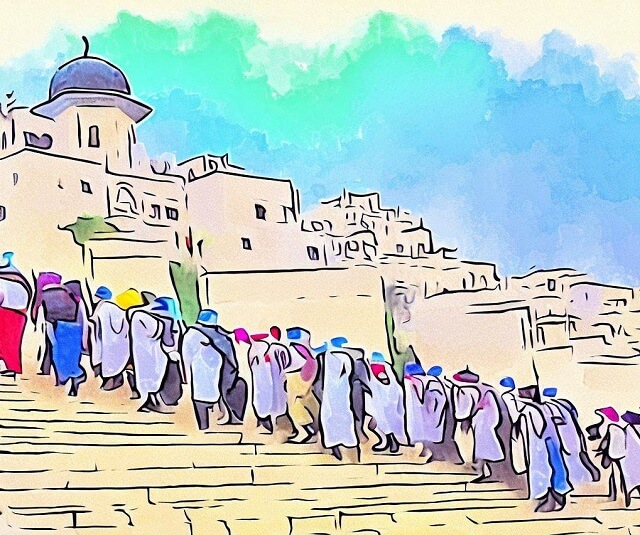
One type of offering brought in the Temple was the korban Todah, the Thanksgiving offering:
This is the law of the Peace offering (Shelamim)... If offered as a thanksgiving offering, then it is presented along with unleavened loaves. (Lev. 7:11-12)
Who brought this offering? The Talmud mentions several examples:
Four need to give thanks: those who sail the seas, those who travel through deserts, the sick who are cured, and prisoners who are freed. (Berakhot 54b)
Why did the Sages choose these four situations as examples of individuals who need to publicly thank God?
Testing Limits
Appreciation does not come naturally to us. The human soul is programmed to constantly strive for more, as it says, “The soul is never satisfied” (Ecc. 6:7). We look ahead, not behind. We are always trying to improve our lot, to experiment and discover new horizons. Thus it is more natural for us to take for granted than to take stock. Often we feel gratitude for what we have by way of contrast: only when we no longer have it, or hear of others who lack, do we begin to truly appreciate it.
Another consequence of the human characteristic to constantly strive for more is our tendency to challenge accepted rules. The testing of limits is particularly pronounced in transitional periods (two-year-olds in their passage from infancy to childhood, and teenagers in their passage from adolescence to adulthood). While this is necessary for personal growth, certain restrictions may only be ignored at great risk. Generally speaking, there are four types of boundaries that people, in their quest for independence, attempt to ignore. They suffer the results of rebelling against natural or moral limits, and their experiences provide a lesson to others.
The first group consists of those who attempt to defy the basic laws of nature that govern humanity. One example of this are those who abandon the land, risking their lives by sailing the seas. Outside of their natural habitat, they will come to appreciate the safety and normalcy of life on land.
The second group includes those who rebel against the laws of the state. Governmental rules help regulate communal life. Those who abandon the rule of law by escaping to the desert (or the frontier) will quickly learn to appreciate the necessity for law and order.
The third group is comprised those who ignore guidelines for personal health care. Their interests and desires override the need to attend to their physical needs. Only when they suffer from illness do they come to appreciate the importance of heeding the rules of health and hygiene.
The final group is made up those who, in their greed for unfettered freedom, reject the ethical laws of society. Their actions pose a threat to others in the community. They must be imprisoned to prevent them from harming others. Hopefully, they will come to the realization that it is better to settle for a limited freedom outside the walls of prison than no freedom at all.
These four types publicly give thanks — if they survive their folly! — and serve as an example to others to appreciate the natural, societal, physical, and moral boundaries that make life livable.
(Sapphire from the Land of Israel. Adapted from Ein Eyah vol. II, p. 252)