The Talmud (Shabbat 31a) tells the story of three Gentiles who wished to convert. In each case, they were initially rejected by the scholar Shamai, known for his strictness, but they were later accepted and converted by the famously modest Hillel.
The Convert Who Wanted to be High Priest
In one case, a Gentile was walking near a synagogue when he heard the Torah being read and translated:
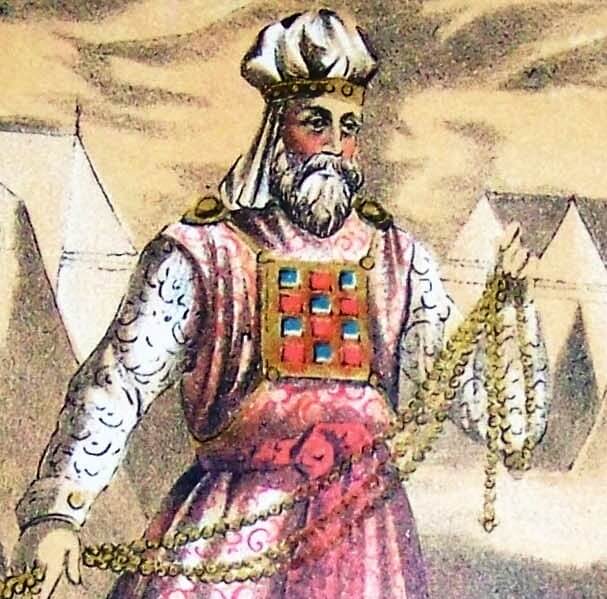
These are the clothes that you should make: the jeweled breast-plate, the ephod-apron... (Ex. 28:4).
His interest was piqued. “For whom are these fancy clothes?” he asked. “They are special garments for the Kohen Gadol, the High Priest.” The Gentile was excited. “For this, it is worth becoming a Jew. I'll go convert and become the next High Priest!”
The Gentile made the mistake of approaching Shamai. “I want you to convert me,” he told Shamai, “but only on condition that you appoint me High Priest.” Shamai rebuffed the man, pushing him away with a builder’s measuring rod.
Then he went to Hillel with the same proposition. Amazingly, Hillel agreed to convert him. Hillel, however, gave the man some advice. “If you wanted to be king, you would need to learn the ways and customs of the royal court. Since you aspire to be the High Priest, go study the appropriate laws.”
So the new convert began studying Torah. One day, he came across the verse, “Any non-priest who participates [in the holy service] shall die” (Num. 3:10). “To whom does this refer?’ he asked. Even King David, he was told. Even David, king of Israel, was not allowed to serve in the holy Temple, as he was not a descendant of Aaron the kohen.
The convert was amazed. Even those born Jewish, and who are referred to as God’s children, are not allowed to serve in the Temple! Certainly, a convert who has just arrived with his staff and pack may not perform this holy service. Recognizing his mistake, he returned to Hillel, saying, “May blessings fall on your head, humble Hillel, for drawing me under the wings of the Divine Presence.”
Shamai’s Rejection and Hillel’s Perspective
A fascinating story, but one that requires to be examined. Why did Shamai use a builder’s measuring rod to send away the potential convert? What did Hillel see in the Gentile that convinced him to perform the conversion?
Shamai felt that the man lacked a sincere motivation to convert. By chance, he had overheard the recitation of the High Priest’s special garments. The garments, beautiful though they may be, represent only an external honor. His aspirations were shallow and superficial, like clothing that is worn on the surface.
Furthermore, the chance incident did not even awaken within the Gentile a realistic goal. How could conversion to Judaism, with all of the Torah’s obligations, be based on such a crazy, impossible fancy — being appointed High Priest? The foundations of such a conversion were just too shaky. Shamai pushed him away with a builder’s measuring rod, indicating that he needed to base his goals on solid, measured objectives.
Hillel, however, looked at the situation differently. In his eyes, the very fact that this man passed by the synagogue just when this verse was being read, and that this incident should inspire him to such a lofty goal — converting to Judaism — this person must have a sincere yearning for truth planted deeply in his heart. He was not seeking the honor accorded to the rich and powerful, but rather the respect granted to those who serve God at the highest level. The seed of genuine love of God was there, just obscured by false ambitions, the result of profound ignorance.
Hillel was confident that as he advanced in Torah study, the convert would discover the beauty and honor of divine service that he so desired through the sincere observance of the Torah’s laws, even without being the High Priest.
Both Traits Needed
Once, the three converts who were initially rejected by Shamai and later accepted by Hillel, met together. They all agreed:
The strictness of Shamai almost made us lose our [spiritual] world; but the humility of Hillel brought us under the wings of God’s Presence.
Rav Kook noted that the converts did not talk about Shamai and Hillel. Rather, they spoke of the “strictness of Shamai” and the “humility of Hillel.” These are two distinct character traits, each one necessary in certain situations. In order to maintain spiritual attainments, we need the traits of firmness and strictness. On the other hand, in order to grow spiritually, or to draw close those who are far away, we need the traits of humility and tolerance. The three converts recognized that it was Hillel’s quality of humility that helped bring them “under the wings of God’s Presence.”
(Gold from the Land of Israel, pp. 152-154. Adapted from Ein Eyah vol. III, pp. 144-147.)