Where was Moses?
The commentaries noted an unusual fact about the Torah portion of Tetzaveh — it is the only parashah, from when we first read of Moses’ birth in the book of Exodus, in which Moses is not mentioned.
The Ba’al HaTurim (Rabbi Jacob ben Asher, 1269-1343) explained that this was a consequence of Moses’ defense of the Jewish people after the Sin of the Golden Calf. At that precarious juncture, Moses pleaded with God to forgive the Israelites; and if not, then “please remove me from Your book that You have written” (Exod. 32:32).
The Sages taught that “The curse of a sage comes true, even if it was contingent on a condition [and that condition was not met]” (Makkot 11a). Thus, even though God did forgive the Jewish people, Moses’ vow was partially fulfilled, and his name was removed from the portion of Tetzaveh.
The question arises: why was this parashah, which describes the special garments of the kohanim, chosen as the one in which Moses is not mentioned? Also, why was Moses punished for valiantly defending the Jewish people?
Concession for Weakness
According to the Midrash, God originally intended to appoint Moses and his descendants to be kohanim. God, however, became disappointed with Moses due to his repeated refusal to lead the Israelites out of Egypt, and He transferred the priesthood to his brother Aaron (Zevachim 102a on Exod. 4:14). But while Moses lost the priesthood, he still retained the potential to be a kohen.
In fact, when the Tabernacle was dedicated, Moses did serve as the kohen, bringing the dedication offerings (Exod. 29). It is surprising that Moses did not wear the special garments of a kohen during his one-time service. If a kohen does not wear these special clothes while serving in the Temple, his service is rendered invalid (Zevachim 17b); and yet Moses performed the dedication service just wearing a white robe (Avodah Zarah 34a). Why didn’t Moses need to wear the priestly garments?
In general, clothing is a concession for human weakness. The Hebrew word begged (clothing) comes from the root baggad, meaning “to betray.” In the Garden of Eden, there was nothing wrong with being naked. It was only after Adam and Eve ate from the Tree of Knowledge of Good and Evil that they needed to hide behind clothes — a necessary but tragic betrayal of their natural purity.
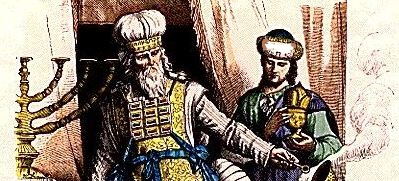
The same is true for the priestly garments. Each of the eight garments, the Sages taught, comes to atone for a particular transgression: arrogance, slander, improper thoughts, and so on (Zevachim 88b). Were it not for these sins, the kohanim would have no need for these special clothes.
Beyond Clothing
The Talmud relates that the white robe that Moses wore when he served in the Tabernacle had no seams. In other words, his robe had no clear and distinct boundaries, nothing to emphasize its separation from his body. It was almost as if Moses needed no clothing at all.
Moses was not tainted by the Sin of the Golden Calf, a sin that the Midrash (Shemot Rabbah 32:1) links to the sin of Adam. Therefore Moses did not need the extra clothes of the kohanim. He understood that, due to the Sin of the Golden Calf, the kohanim would need to wear special garments. Therefore he asked God: “Please remove me from Your book” — please remove me from the portion of Your book that commands the kohanim to wear special clothes. I was not involved in the Sin of the Golden Calf, and I have no connection with the need for these clothes.
What is so terrible about the priestly garments? These clothes indicate that the kohanim suffer from a fundamental dissonance. While they wear their special clothes, the kohanim are shluchei dedan and shluchei deRachmana, our emissaries to God and God’s emissaries to us. But when they remove the priestly garments, they become private individuals once again.
Moses, on the other hand, was a “servant of God” (Deut. 34:5). This was not an honorific title, but a description of his very essence, regardless of what clothes he wore. Divine service was not a duty that Moses took upon himself during certain hours of the day. It was his defining quality.
God heeded Moses’ request and removed his name from the portion of Tetzaveh. And indeed Moses had no need for these clothes, but performed the Divine service wearing only a seamless white robe.
(Sapphire from the Land of Israel. Adapted from Shemuot HaRe’iyah Tetzaveh (1929), quoted in Peninei HaRe’iyah, pp. 175-176).