What is so important about the construction of the Tabernacle that the Torah describes in such loving detail its measurements and furnishings? Was it not just an interim precursor to the Temple? What eternal message does this temporary structure have to impart?
The Tabernacle enabled the Jewish people to express their devotion and love of God. But the Tabernacle was more than just a hallowed place to serve God. By examining its structure and parts, we may reveal the paths by which the human soul draws close to its Maker.
The Mishkan, the Altar, and the Ark
The two largest objects of the Tabernacle were the mishkan structure, composed of upright wooden beams, and the copper altar that stood in the courtyard. These parts of the Tabernacle symbolize the path of contemplation and reflection. The design of the mishkan reflects the overall structure of the universe. Careful examination of its dimensions and details, like contemplation of the universe in which we live, leads us to recognize the world’s spiritual foundations. Through His creative acts, we gain awareness of the Creator.
The altar is a continuation of this path of reflection. The soul’s meditation on the inner nature of the universe awakens within us love and awe for God and the desire to serve Him. This was the function of the altar, the focal point for serving God in the realms of emotion and deed.
Together, the mishkan and the altar formed a complete framework of Divine service. Thus, Talmudic tradition (Shabbat 92a) connects them with a hekesh, teaching that both reached full stature: “Just as the mishkan was ten cubits tall, so, too, the altar was ten cubits tall.”
The third major furnishing of the Tabernacle was the aron, the gold-plated ark encasing the stone tablets from Sinai. The ark represents the path of Torah, enlightenment through God’s word that transcends the limitations of the human mind.
Carrying with Poles
The copper altar was not lifted directly but via wooden poles. So, too, our reflection on the inner nature of the universe does not come naturally, without effort. The service of God as represented by the altar is performed by using the analytic and contemplative faculties of the soul.
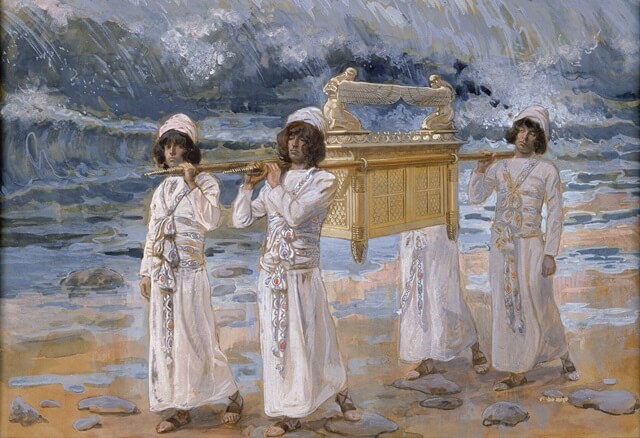
The ark containing the tablets was also carried with poles, indicating that we approach the Torah with our physical senses and intellect. However, these paths go beyond the overt abilities of the soul. The Sages taught that “anything carried by poles, one third is above [the porter’s height] and two thirds are below.” Two thirds are within the realm of our revealed faculties, the senses and the intellect. One third, however, rises above the human mind. It comes from the hidden recesses of the soul; we are able to connect to the Torah only through spiritual gifts.
Above Ten Handbreadths
The Sages taught that the furnishings of the Tabernacle were carried ten handbreadths (about 90 cm.) above the ground. What is the significance of this height? Ten handbreadths designate an individual’s place and legal domain (reshut). This measurement signifies our binds to the physical realm. Our ties to the material world are so powerful that even Moses and Elijah were unable to escape the constraints of ten handbreadths (Sukkah 5a).
Rabbi Elazar taught that, in general, people carry their loads above ten handbreadths, like the Levites who were charged with transporting the Tabernacle furnishings (Shabbat 92a). By extension, we may say that the calling of every individual is like the mission of the Levites; our purpose in life is to carry our load above ten handbreadths.
We must aspire to transcend the physical forces that bind us to the earth, going beyond our material needs. Just as the Levites carried the altar and the ark above ten handbreadths, we too should utilize these two paths — contemplation of the universe, with its resultant emotional and practical service, and the study of Torah, God’s elevated word — to transcend the material binds of our physical nature.
(Gold from the Land of Israel, pp. 149-151. Adapted from Ein Eyah vol. IV, pp. 232-233.)
Illustration image: ‘The Ark Passes Over the Jordan’ (Jacques Tissot, 1896-1902)