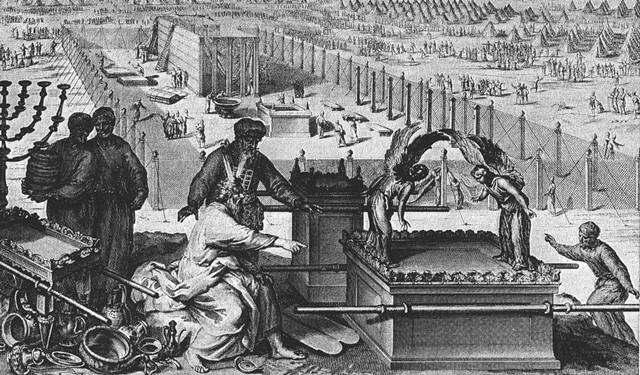
In preparation for building the Tabernacle, God commanded Moses to collect the necessary materials:
Speak to the Israelites and have them take for Me an offering. From every person whose heart inspires him to donate, you shall take My offering. (Ex. 25:2)
Why did God command Moses to take the donations? The verse should read that they must give an offering!
The language of “taking” might lead one to conclude that the materials could have been taken from the people by force. But this was not the case, for the Torah stresses that the offerings were donated freely — “from every person whose heart inspires him to donate.”
Why, in fact, did this collection need to be voluntary? The Talmud in Baba Batra 8b teaches that a community may force members of the community to support the poor and the needy. Using our money to help others is a trait that needs to be trained and developed. So why did God command that these gifts for the Tabernacle, the first act of tzedakah (charity) on a national level, be donated solely out of sincere generosity?
Two Goals of Tzedakah
The mitzvah of tzedakah is meant to accomplish two objectives. The first concerns the person receiving the charity. Through this mitzvah, the poor are provided with what they lack. The second objective concerns the one giving. By donating our time and money, we express our inner qualities of chessed and kindness in a concrete and tangible manner. The act of tzedakah actualizes our traits of generosity and contributes toward our own spiritual growth.
We can distinguish between these two objectives within the act itself. The first goal stresses the aspect of giving to the needy. The important factor here is that the poor person receives the assistance he needs. The second goal, on the other hand, stresses the aspect of taking from the benefactor. This is a special benefit of the mitzvah of tzedakah: by relinquishing our material possessions for the sake of others, we refine our character traits and elevate the soul.
Which of these two goals is the principal objective of tzedakah?
The Gimmel’s Chase
The Sages in Shabbat 104a noted that the Hebrew letter Gimmel appears to be facing the next letter in the alphabet, the Dalet, with its left ‘leg’ stretched out toward the Dalet. Why is the Gimmel running toward the Dalet?
The Sages explained that the Gimmel is the benefactor (from the word gommeil, meaning one who gives or supports). The Gimmel is chasing after the impoverished Dalet (from the word dal, meaning ‘poor’ or ‘needy’) in order to help him.
Why is the benefactor running after the poor? Should it not be the other way around?
The Sages wanted to teach us that the principal aim of tzedakah is connected to the very foundations of the universe. The true goal of tzedakah is to elevate the soul of the giver. After all, if the purpose was to help the poor, God could have provided other means for their support without having to rely on the generosity of society. The shapes of the Hebrew letters — letters which God used to create the universe — hint at this fundamental truth. The Gimmels, the benefactors, need to pursue the Dalets, the poor, in order to grow and develop spiritually.
Thus the Jewish people’s very first philanthropic project emphasized that the central aspect of tzedakah is not giving to the needy, but taking from the donor. “Have them take for Me an offering.” God commanded that the contributions to the Tabernacle be given freely — “every person whose heart inspires him to donate” — since the soul and its traits are only refined when one donates willingly.
(Sapphire from the Land of Israel. Adapted from Otzarot HaRe’iyah vol. II, pp. 189-190)