The Torah describes in great detail the vehicle for bringing God’s Presence into our world: the Mishkan (Tabernacle), the forerunner of the holy Temple in Jerusalem.
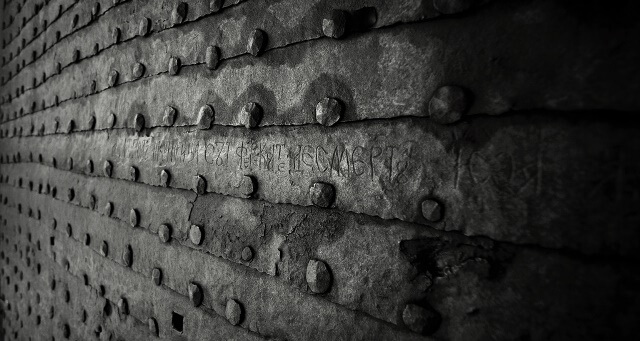
The Beit HaMikdash, the holy Temple in Jerusalem, was a focal point of Divine service, prayer, and prophecy; a vehicle to bring the Shechinah into the world. The current state of the world, without the Beit HaMikdash, is one of estrangement from God. When the Temple was destroyed, the Talmud teaches, the gates of prayer were locked and a wall of iron separates us from our Heavenly Father (Berakhot 32b).
Why did the Sages describe this breach of communication with God as a “wall of iron”? Why not, for example, a “wall of stone”?
A World Ruled by Iron
The metaphor of an iron wall, Rav Kook explained, is precise for several reasons. A stone wall is built slowly, stone by stone, layer by layer. An iron wall is more complex to construct; but when it is erected, it is set up quickly. The Temple’s destruction and the resultant estrangement from God was not a gradual process, but a sudden calamity for the Jewish people and the entire world, like an iron gate swinging shut.
But there is a deeper significance to this barrier of iron. The fundamental aim of the Temple is the exact opposite of iron. Iron is a symbol of death and destruction; implements of war and slaughter are fashioned from metal and iron. Iron is a material used to shorten life. The Temple, on the other hand, is meant to lengthen life. Its purpose is to promote universal peace and enlightenment — “My House will be called a house of prayer for all the nations” (Isaiah 56:7). The incompatibility between iron and the Temple is so great that iron could not be used to hew the stones used in building the Temple (Deut. 27:5, Middot 3:4).
With the Temple’s destruction, the sweet music of prayer and song was replaced by the jarring cacophony of iron and steel, reaping destruction and cutting down life. At that tragic time, the spiritual and prophetic influence of the Temple was supplanted by the rule of iron. Only when justice and integrity will be restored, when the world will recognize the principles of morality and truth, will this wall of iron come down, and the Beit HaMikdash will once again take its place as a world center of prayer and holy inspiration.
(Silver from the Land of Israel. Adapted from Ein Eyah vol. I on Berakhot 32b (5:76).)