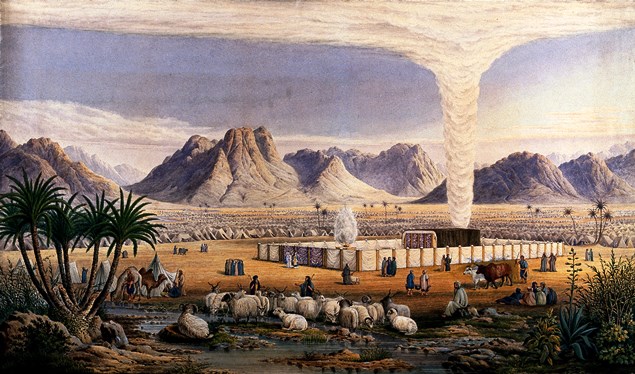
The Torah reading of Terumah begins the section dealing with building the Mishkan (Tabernacle) and making the priestly clothes. These chapters are among the few in which the Torah places great emphasis on external beauty — art, craftsmanship, and aesthetics.
Of particular interest is the protagonist of this unique construction: the master craftsman, Betzalel. The Midrash weaves many stories about Betzalel’s wisdom and skill. In particular, the Sages noted the significance of his name, which means, “in God’s shadow”:
Betzalel’s name reflected his wisdom. God told Moses, ‘Tell Betzalel to make the tabernacle, the ark, and the vessels.’
When Moses relayed the message to Betzalel, however, Moses changed the order, mentioning first the ark, then the vessels, and lastly, the tabernacle.
Betzalel turned to Moses. ‘Moses, our teacher, usually one first builds the house, and then places the furniture inside. Yet you said to make the vessels and then the tabernacle. These vessels that I will make — where shall I put them? Perhaps God told you, “tabernacle, ark and vessels”?’
Moses replied in amazement, ‘You must have been in God’s shadow and overheard!’ (Berakhot 55a)
Betzalel was certainly sharp to be able to reconstruct the original divine message. Why did Moses change the order that God had told him?
The Scholar and the Artist
One way in which we can distinguish between the scribbles of a five-year-old and a masterpiece by Rembrandt is the degree to which the work of art reflects reality. A true artist is acutely sensitive to the finest details of nature. He must be an expert in shading, color, texture, and composition. A great artist will be disturbed by the smallest deviations, just as a great musician is perturbed by a note that is not exactly right in pitch, length, and emphasis.
There is a difference between the natural order of the world as perceived through the trained eye of an artist, and the proper order as understood through the wisdom of a scholar. The artist always compares the subject at hand to reality. The scholar, on the other hand, organizes topics according to their ethical and spiritual significance.
When Moses heard God command that Betzalel build the “tabernacle, ark, and vessels,” he did not know whether the order was significant. Since the tabernacle was in effect just the outer building containing the ark and the other vessels, Moses knew that the ark and vessels were holier. Therefore, when relaying the command to Betzalel, he mentioned them in order of importance, starting with the most sacred.
Why then did God put the tabernacle first? Moses decided that the original command started with the general description — the Tabernacle, the overall goal — and then continued with the details, the ark and vessels.
Betzalel, an artist with a finely tuned sensitivity to physical reality, noticed the slight discrepancy in Moses’ description. He realized that the word tabernacle did not refer to the overall construction, but to the outer building. As such, it should have come first, just as in the building of any home. The order was not from the general to the detailed, nor from the less holy to the holier, but from the outside to the inside.
Moses then comprehended the significance of Betzalel’s name, "in God’s shade.” Why shade? Wisdom may be compared to light, while artistic talent is like shade. Light is certainly greater and brighter then shade; but if we want to perceive an object completely, we need to see all of its aspects, both light and shade. In order that the Tabernacle could achieve its purpose, it required the special artistic insight of Betzalel.
(Gold from the Land of Israel, pp. 144-146. Adapted from Ein Eyah vol. II, p. 262.)