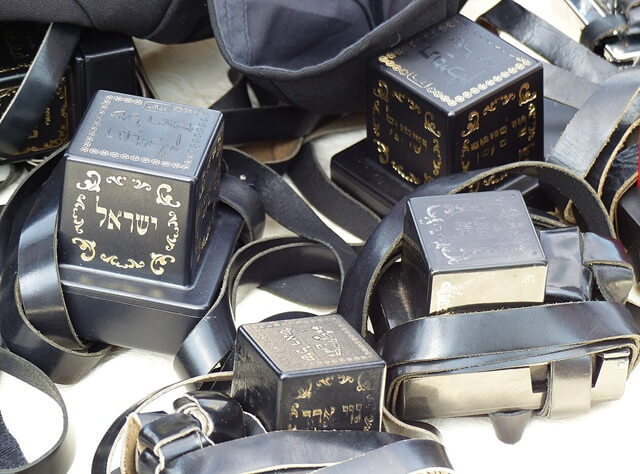
Tefillin, the Sages taught, must be treated with respect.
One who hangs his tefillin [on a hook or by the straps] — his life will be suspended. The dorshei reshumot [homiletical exegetes] taught: Your life will hang in doubt before you (Deut. 28:66) — this refers to one who hangs his tefillin. (Berakhot 24a)
One who hangs tefillin on a hook or holds them by their leather straps is certainly acting carelessly, displaying a cavalier attitude to such a holy object. But does it truly endanger one’s life?
Spiritual Ties
A healthy person has an innate love of life. If a person needs to be convinced to stay alive — this is a sign of serious illness, either physical or mental. Normal people do not require logical arguments to live.
The curse of “your life will hang in doubt before you” refers to such an abnormal state, when one’s very survival is in question. It indicates grave danger or illness. The Hebrew text speaks of one whose life is hanging 'meneged' — ‘before’ or ‘across from him.’ In other words, is not within one’s natural realm of existence, but is external, outside of one’s inner self. The will to live is no longer obvious and innate.
This tragic condition has a corresponding spiritual state. For those who are spiritually healthy, the fundamental teachings of the Torah and its axioms of faith are firmly ingrained. The spiritually whole do not require intellectual arguments or proofs to know that they share the destiny of Israel and its special mission. They have a natural connection to God and Torah, reinforced by observing mitzvot and a sincere love for the Jewish people.
The mitzvah of tefillin in particular helps bind us to the path of Torah in thought and emotions. The tefillah shel rosh, worn over the mind, elevates our thoughts; and the tefillah shel yad, worn across from the heart, impresses holy emotions. By wearing tefillin, “God’s Torah will be in your mouth” (Ex. 13:9) — the Torah’s teachings will be naturally on our minds and lips.
This state is fortified by wearing tefillin regularly and treating them with respect. Even when removing one’s tefillin, they should be stored in a safe and secure location. Hanging one’s tefillin on a hook, however, indicates an unsteady state. Such behavior reveals a distant and estranged attitude, a tenuous connection to Torah. This is like an ailing individual whose connection to life is shaky.
The Sages were not just calling our attention to the linguistic similarity between “hanging one’s tefillin” and one’s life “hanging in doubt.” They were dorshei reshumot — they had insight into how impressions (reshumot) are made on the soul. They understood that the spiritual phenomenon is similar to the physical one. A person who carelessly hangs his tefillin on a hook — whose connection to holiness and spiritual matters is tenuous — is like one whose natural will to live is in question. "And your life will hang in doubt before you.”
(The Splendor of Tefillin. Adapted from Ein Eyah vol. I on Berakhot 3:50, p. 107)