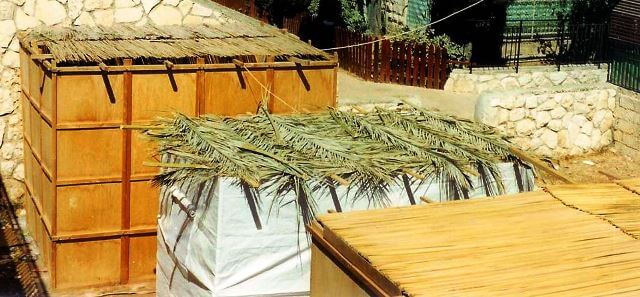
The sukkah booth that we live in during the Succoth holiday is by definition a temporary dwelling. The Sages ruled that a very tall structure, over ten meters high, is invalid as a sukkah because it is a permanent structure. An exposed hut consisting of only two walls and a handbreadth for the third, on the other hand, is perfectly acceptable.
And yet, this rickety booth is our protective fortress. As King David said, “You protect them in a sukkah from the strife of tongues” (Psalms 31:21). Why should such a flimsy structure be a paradigm of protection and safety?
The Sukkot of the Great Assembly
To better understand the metaphor of the sukkah, we should examine a remarkable Talmudic passage. In Nehemiah 8:17 it states that, from the time of Joshua, the Jewish people had not dwelt in sukkot until the mitzvah was reinstated after their return from the Babylonian exile. How is it possible that this mitzvah was neglected for so many centuries?
The Talmud in Arachin 32b explains that the Jewish people always performed the mitzvah of dwelling in a sukkah. However, the sukkot erected by the Great Assembly in the time of Nehemiah were special sukkot, possessing a protective quality that had not existed since the days of Joshua bin Nun. According to the Talmud, these were not even physical sukkot, but rather a unique spiritual act of Ezra and the Great Assembly: “They prayed and abolished the passion for idolatry, and this merit protected them like a sukkah.”
The Ultimate Fortress
Clearly, the protective aspect of the sukkah is of a spiritual nature. The eternal truth is that the sukkah — purposely defined as a structure so flimsy that it cannot even be called a proper dwelling — is a fortress that protects us from all adversaries and foes. What is it that transforms the exposed sukkah into a shelter and stronghold? Certainly not any of its physical properties. Rather, its source of inner strength is none other than God’s word. The sukkah protects us by virtue of the Torah law that declares this structure to be our shelter during the holiday of Succoth.
This is an important message for all times, and especially in our generation. We need great courage to return to the land of our fathers and rebuild our national home. Where can we find the moral and spiritual resolve to withstand the challenges of those who oppose our return and deny our right to a homeland in Eretz Yisrael? Like the sukkah dwelling, our national home is based on the spiritual strength of God’s eternal word. The most advanced weapons may be able to penetrate the thickest walls, but they cannot prevail over the stronghold of God’s word.
This is our fortress, our ultimate shelter of security: God’s eternal promise that the Jewish people will return to their land and the House of Israel will be built once again.
The protective sukkah of the Great Assembly was the merit provided by their spiritual efforts to abolish the desire for idolatry. Our right to the land of Israel is similarly based, not on our military prowess, but on the moral strength of our eternal covenant with God and the merit of the Torah’s mitzvot.
Beautifying the Law
However, we should not be satisfied with keeping only the minimum requirements of Torah law. Jerusalem was destroyed, the Sages taught, because the judges ruled according to the strict letter of the law. They failed to take into account the spirit of the law and seek a ruling that is both just and compassionate — lifnim mishurat ha-din (Baba Metzi'ah 30b).
The mitzvah of sukkah is based on Divine law, but there is an ancient custom to adorn the sukkah with decorated fabrics, fruits, and grains (Sukkah 10a). We should similarly seek to “adorn” the Torah law. We should go beyond the minimum requirements of the Law and aspire to the highest level of God’s word, in its purest ethical form. Then we will merit that “David’s fallen sukkah” (Amos 9:11), the prophet’s metaphor for Jewish sovereignty, will rise again, speedily in our days.
(Silver from the Land of Israel. Adapted from Ma’amarei HaRe’iyah vol. I, pp. 149-150)