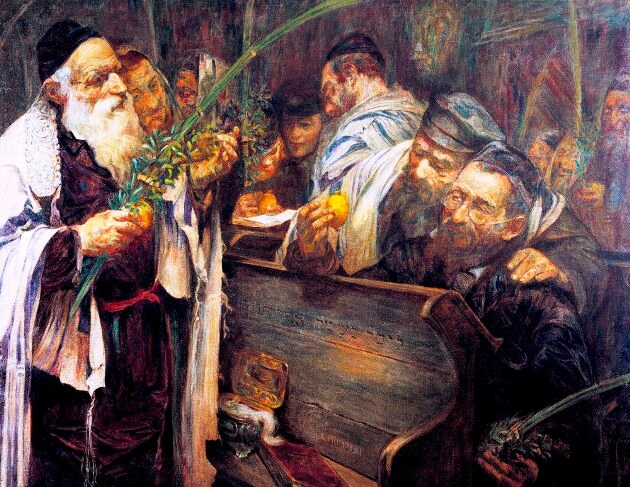
You have to feel sorry for the poor aravah, the willow branch waved together with the other three species of the arba’ah minim on Succoth. It lacks the fragrance of the etrog and the myrtle, and, unlike the date-palm, it bears no fruit. The willow has come to represent the simple folk who are neither learned in Torah nor respected for numerous good deeds.
And yet, according to an ancient oral tradition, the aravah becomes the star of the show on Hoshanah Rabbah, the last day of the Succoth holiday. When the Temple stood in Jerusalem, the kohanim would raise tall willow boughs around the altar. In synagogues nowadays, after waving all four species, we set aside the other three species and raise the willow alone. And then, at the end of the Hoshanah prayers, the congregants beat the willow on the floor.
Why does the lowly willow merit this special attention? And what is the meaning behind the age-old custom of striking the floor with willow branches?
Sabbath Desecration in Jaffa
Rav Kook related the following story one holiday evening in his sukkah. The incident took place in Jaffa, where Rav Kook served as chief rabbi from 1904 to 1914. One Shabbat day, a secular photographer came and disturbed the Sabbath peace in a religious neighborhood. In total disregard for the local religious sensibilities, he set up his tripod and camera in the middle of the street and began taking pictures.
This public desecration of the Sabbath deeply angered the local residents. One man who was particularly incensed by the photographer’s insensitivity took a pail of water and thoroughly soaked the Sabbath-desecrater. Naturally, the photographer was indignant. He was so confident in the justice of his cause that he registered a complaint against the water-douser — at the beit din (religious court) of the rabbi of Jaffa, Rav Kook.
Rav Kook told the photographer, “I see that you fail to understand the severity of desecrating the Sabbath in public, but you should realize that your action was a serious affront to the community. You entered a neighborhood of Sabbath-observers and offended them deeply.
“Or course, the correct course of action for the residents would have been to rebuke you verbally. Perhaps you would have understood the seriousness of your actions and stopped. Had that man consulted with me first, I would have advised him not to throw water on you.
“However, he didn’t ask, but reacted spontaneously. You should know that on occasion, such impulsive reactions are justified. When people disregard societal norms and cross accepted boundaries, regardless of the implications for others, it is often the spontaneous reaction that most effectively prevents future abuse.
“Such an occasion took place when the Israelites were in the desert and Pinchas responded, not accordingly to the normative Halachah, but as a zealot: "Kena'im pogim bo” (‘Zealots punish them’ — Num. 25:6-8; Sanhedrin 82a). If Pinchas had asked beforehand, he would have been instructed not to kill Zimri. But since his act was done sincerely and served to prevent future violations, his zealous deed was approved after the fact.”
The Boethusians and the Willow
What about the willow and Succoth? Rav Kook continued his explanation that evening:
The lowly willow represents the common folk, unlearned and lacking exceptional deeds. Yet, these ‘willows’ are blessed with an abundance of common sense and are unencumbered by sophisticated calculations. As a result, they have filled important roles in the history of the Jewish people.
In Talmudic times, there was a sect called the Boethusians who disagreed with many of the rulings of the Sages. One disagreement concerned the willow ceremony. The Boethusians prohibited observing this ceremony on the Sabbath.
One year, when Hoshanah Rabbah fell on the Sabbath, the Boethusians took the willows and covered them with stones. They knew the Rabbis would not permit moving the stones on the Sabbath since stones are muktzeh (various categories of objects, such as stones, money, and work tools, that the Rabbis prohibited to be handled on the Sabbath in order to safeguard the sanctity of the day).
On Shabbat morning, however, some simple folk who were ignorant about the prohibition of muktzeh pulled out the willow boughs from under the stones. Then the kohanim were able to raise the willows alongside the altar (Sukkah 43b).
Why does the Talmud emphasize that this praiseworthy act was performed by common folk? By covering the boughs with stones, the Boethusians had placed the Sages in a quandary. If the willow boughs were not used, the Boethusians could cite this as proof that the rabbis had conceded to their opinion that willows should not be raised on the Sabbath. On the other hand, if the rabbis decided to move the stones, the Boethusians could have announced that the rabbinic prohibition of muktzeh had been abolished.
Fortunately, the problem never materialized. The simple Jews resolved the dilemma in their own typical manner. They did not ask questions; rather, alarmed by the scandal, they responded by simply removing the willows from under the stones.
The Role of the Willow
The custom to hit the floor with willows does not mean that we wish to ‘punish’ the willow, as is often thought, for its lack of Torah and good deeds. Rather, it is meant to demonstrate that the willow is also a force to be reckoned with — a natural, healthy power that is part of the arsenal of the Jewish people. We do not strike the willow. We strike with the willow.
(Silver from the Land of Israel. Adapted from Mo'adei HaRe’iyah, pp. 111-113.)
Illustration image: ‘Sukkot in the Synagogue’ (Leopold Pilichowski, 1894)