Three Types of Courts
The Torah commands that a system of courts and police be established in every town. The Torah’s judicial system contains three levels of courts:
-
Regular courts of three judges who deal with matters of civil law — litigation and other monetary cases (in Hebrew, dinei mamonot).
-
Higher courts made up of 23 judges who hear cases relating to capital crimes (in Hebrew, dinei nefashot). These courts were called ‘Minor Sanhedrins.’
-
A supreme court consisting of 71 judges, called the ‘Great Sanhedrin.’ Located in the Temple complex in Jerusalem, this high court had two functions: (a) to clarify the law in new or unclear cases, and (b) to promulgate new decrees.
The Complexity of Civil Law
Acceptance to the bench of the Great Sanhedrin was certainly most prestigious. All judges are required to be wise and humble, to love truth and hate bribery, to be well-liked and respected. Members of the Supreme Court were expected to be among the greatest scholars of the generation. They needed to be proficient in many of the sciences, such as medicine and astronomy.
We would similarly expect that membership in a Minor Sanhedrin court would demand a greater level of scholarship than participation in a humble three-member court. However, the Talmud indicates that cases of civil law require greater expertise and wisdom than the capital crimes that are judged in the Minor Sanhedrins.
A student who has humbly accepted his teacher’s rebuke on two occasions will be worthy to distinguish between civil law and laws of capital crimes.
As Rabbi Ishmael taught: One who wishes to be wise should study civil law, for no other area of Torah study is as intricate; it is like a flowing wellspring. (Berakhot 63b)
This Talmudic statement raises a number of questions. What sort of reward is this for a suffering student? And why is civil law more complex than other areas of Torah?
Civil versus Criminal Law
For some students, proficiency in their studies comes easily and quickly. Other students must struggle in order to master the material. The student who perseveres in his studies, despite blunders in class, will be compensated for his efforts. As a reward for his diligence and determination, he will not only grasp the particulars of the law, but will also gain insight into its underlying principles. This insight goes beyond the actual details, which are taught directly. It reflects a much more profound understanding of the subject matter.
Civil and capital crimes are both areas of law, yet they differ fundamentally in their objectives. The primary goal of civil law is to resolve monetary disputes between individuals and restore property to its rightful owner. It is only as a secondary goal that current or future benefits to society as a whole are taken into consideration. Capital crimes, on the other hand, are usually cases where there is nothing that can be rectified or returned. Here the primary goal is to protect society from future offenses.
Because of this fundamental difference, monetary law is intrinsically more complicated. Since the judge must decide between conflicting claims of ownership in all of the numerous situations of interpersonal relations, this type of law inherently deals with many more intricate details and complex issues. Study of civil law is therefore one of the most challenging areas of Torah study. True mastery of this subject requires a profound understanding of the underlying issues — an understanding that can be attained only by the most diligent and persevering students.
(Sapphire from the Land of Israel. Adapted from Ein Eyah vol. II, p. 391)
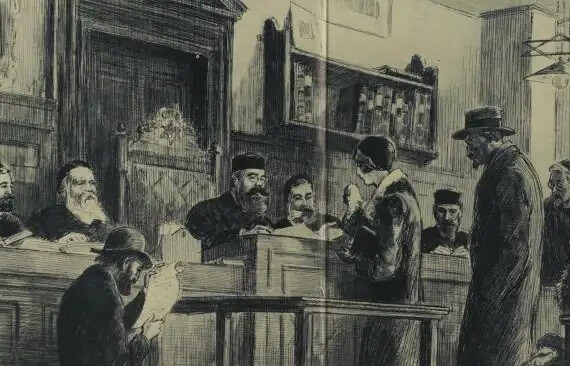
Illustration image: London Beth Din (Illustrated London News, 1926)