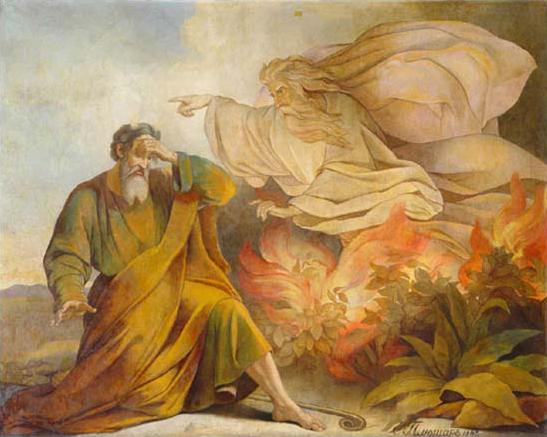
Appearing in a burning bush, God charged Moses with the task of leading the Jewish people out of Egypt. Moses, however, had doubts about the feasibility of the mission:
They will not believe me and they will not listen to me, because they will say, ‘God did not appear to you.’ (Ex. 4:1)
In fact, Moses was wrong. The Hebrew slaves did believe him. Why did Moses doubt God’s plan? How could the “master of all prophets” so gravely misjudge his own people?
Another curiosity is the nature of the miraculous signs God provided Moses to prove his authenticity — a staff that transforms into a snake, a hand that becomes leprous, and fresh water that turns into blood. None of these are particularly auspicious omens!
Hidden Treasure of the Soul
What is faith? The wonderful trait of emunah (faith), in its purest form, is a hidden quality of the soul. It is unlike any other wisdom or intellectual awareness. It is an integral part of the inner soul, forming the very basis for life, its light and splendor.
However, this source of happiness and eternal life is not always discernible to the outside world. We are not even fully aware of the magnitude of our own resources of faith. Certainly, its true dimensions are concealed from others.
The Israelites in Egypt had sunk to the lowest levels of corruption and idolatry. Outwardly, they were indistinguishable from their Egyptian masters. The two nations were so similar that the Torah describes the Exodus from Egypt as “taking a nation from the midst of a nation” (Deut. 4:34). It was like removing a fetus encapsulated in its mother’s womb.
In such a state of affairs, even the penetrating eye of Moses failed to detect the people’s inner reserve of faith. Too many masks and covers concealed the holy light of their inner faith. This hidden treasure of the Jewish people, their eternal heritage, was only revealed to God. The Sages taught in Shabbat 97a,
God knew that Israel would believe. He told Moses, ‘They are believers, the children of believers. But you will lack faith in the future!’ As it says (Num. 20:12) [regarding the incident at Mei Merivah, the Waters of Dispute], ‘You did not believe in Me, to sanctify Me in the presence of the Israelites.’
Unquestionably, the inner fire of faith always burns in the soul. It is an intrinsic aspect of the Jewish soul, regardless of choices made and paths taken. If we judge only according to external actions, however, there may not be any outward expression of this inner spark. This was God’s message to Moses: if you measure faith only by what occurs in the outer realm of deed, then even the greatest and most perfected individuals — even spiritual giants like Moses — can stumble, and fail to act upon their inner faith.
The Message of the Signs
The Sages explained that the various signs were a punishment for being unjustly suspicious of the people. The sign of leprosy was particularly appropriate for the message that God wanted to impart to Moses. Leprosy afflicts the skin, the outer layer of the body. This sign hinted to Moses: there may occur imperfections on the exterior, and the external expression may not match the inner holiness, but the holy light of divine faith is always safeguarded within the inner soul.
One cannot claim that the Jewish people will not believe the word of God, even when their lives appear dark and tarnished. This discoloration is only superficial, as it is written, “Do not look upon me [disdainfully] because I am black; for [it is only] the sun that has darkened me” (Song of Songs 1:6).
(Gold from the Land of Israel, pp. 103-105. Adapted from Ein Eyah vol. IV, pp. 241-242)
Illustration image: ‘God Appears to Moses in Burning Bush’ (Eugène Pluchart, 1848)