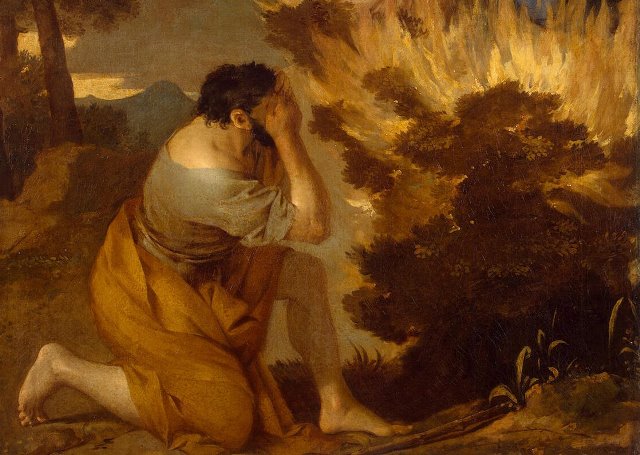
Moses was not eager to accept the mission of leading the Jewish people out of Egypt. He foresaw the immense challenges ahead, including the difficulty of gaining the trust of an embittered and enslaved people.
"So I will go to the Israelites and say to them, ‘The God of your fathers has sent me to you.’ They will ask what His name is; what should I tell them?"
God replied to Moses, "'I Will Be Who I Will Be.' This is what you should tell the Israelites: 'I Will Be' has sent me to you." (Exodus 3:13-14)
What do these enigmatic names — ‘I Will Be Who I Will Be’ and ‘I Will Be’ — mean? Moreover, God seems to give Moses two different answers. Which name was Moses meant to use when identifying God to the people?
I Will Be With You
The Talmud (Berakhot 9b) explains God’s response as follows:
"Go tell the Israelites: ‘I Will Be Who I Will Be.’ ‘I Will Be’ with you in this exile, and ‘I Will Be’ with you in future exiles."
Moses exclaimed, "Master of the Universe, we have enough troubles already! Why mention future suffering?"
God agreed. “Go tell them: ‘I Will Be’ has sent me to you.”
This explanation, however, creates new difficulties. Did God need Moses to explain human psychology to Him? Did Moses understand the emotional state of the people better than their Creator?
A Guide for All Times
God’s message to the Jewish people was that the Torah and its mitzvot would enable them to reach their highest potential. The Torah would guide them throughout history, in all situations, whether as a subjugated people in exile or as a free people in their own land.
God wanted the people to know that the redemption from slavery in Egypt was not a one-time rescue mission. They were leaving Egypt in order to receive the Torah at Sinai. The Divine name "I Will Be Who I Will Be” was meant to convey a fundamental message: the Torah is a guide for all times, a path that would sustain the people even during future exiles and troubled times.
God never intended, however, that Moses would use this name. Moses was not supposed to explicitly mention future exiles and further dishearten a downtrodden people. Rather, Moses was to tell them the shorter name, ‘I Will Be.’ The subjugated nation would be informed that God is with them now: “I Will Be” with you in this exile, and I will redeem you. And they would understand that the Torah will also guide their lives as an independent nation in their own land.
Implicit within the name “I Will Be,” however, lies a deeper message. As a free people in the Land of Israel, the Torah would prepare them to be an eternal nation, capable of withstanding the challenges of future exiles. “'I Will Be’ with them in this exile, and ‘I Will Be’ with them in future exiles.”
(Sapphire from the Land of Israel. Adapted from Ein Eyah vol. I, pp. 45-46)
Illustration image: Burning bush (Sébastien Bourdon, 1616-1671)