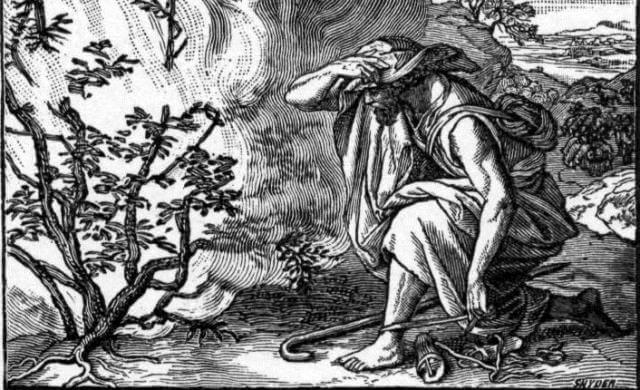
God’s angel appeared to [Moses] in the heart of a fire, in the midst of a thorn-bush. . . . Moses hid his face, since he was afraid to look at God. (Exod. 3:2,6)
During Moses’ first prophetic revelation, he covered his face, afraid to look directly at this holy sight. Was his response an appropriate display of awe and reverence? Or did it reflect a flaw in Moses’ personality, a sign of unwarranted timidity?
This question is the subject of a Talmudic disagreement in Berakhot 7a. Rabbi Yehoshua ben Korcha noted that, later on, God would inform Moses, “You will not see My face” (Exod. 33:23). In effect, God told Moses: “When I wanted [at the burning bush], you did not want. Now that you want, I do not want.” Moses had missed an extraordinary opportunity when he turned away from the burning bush. Because of his failure to strive for greater enlightenment, at Mount Sinai he would only merit a lesser prophetic vision.
Rabbi Yonatan, on the other hand, argued that Moses’ action was praiseworthy. As reward for humbly hiding his face, Moses merited that his face would shine with a brilliant light as he descended from Mount Sinai (Exod. 34:29).
Human Perfection
Rav Kook explained that this Talmudic discussion revolves around a fundamental question regarding our principal aim in life. In what way do we fulfill our potential? How do we achieve perfection?
According to Maimonides, human perfection is attained though the faculties of reason and intellect. Our goal is to gain enlightenment and knowledge of the Divine, through the study of Torah and metaphysics. This is also the viewpoint of Rabbi Yehoshua. By hiding his face at the burning bush, Moses lost a golden opportunity to further his understanding of the spiritual realm. If our fundamental purpose in life is to seek enlightenment, Moses’ demonstration of humility was out of place.
The author of Duties of the Heart, however, wrote that our true objective is the perfection of character traits and ethical behavior. This concurs with the opinion of Rabbi Yonatan. What Moses gained in sincere humility and genuine awe of Heaven at the burning bush outweighed any loss of knowledge. Since the overall goal is ethical perfection, Moses’ action was proper, and he was justly rewarded with a radiant aura of brilliant light, a reflection of his inner nobility.
(Gold from the Land of Israel, pp. 101-102. Adapted from Ein Eyah vol. I, p. 32)