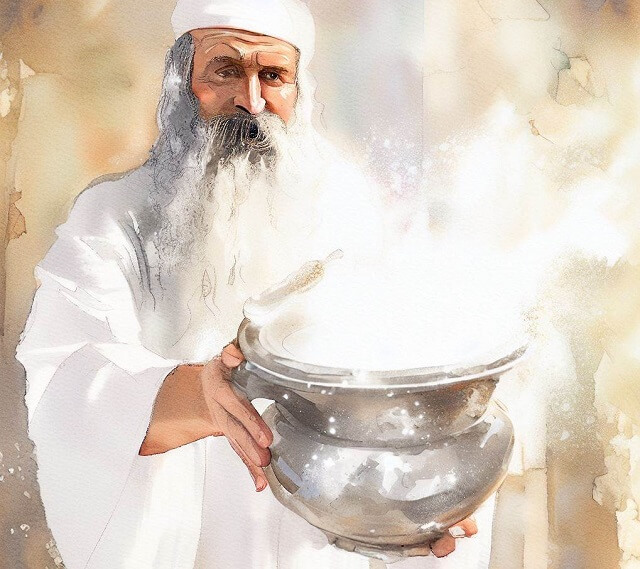
Bringing an offering in the Temple requires more than just a bull, goat, or sheep. In Num. 15:1-16, the Torah commands that korbanot be accompanied by wine libations, called nesachim, and flour offerings, called menachot. What was the purpose of these additional offerings of wine and flour?
The answer to this question may be found in a Talmudic statement comparing the Temple service with our own daily service of prayer. Rabbi Yochanan taught:
Reciting the Shema without tefillin is like offering an Olah [a burnt-offering] without its flour offering, or a sacrifice without wine. (Berakhot 14b)
What is the connection between an incomplete Temple offering and reciting the Shema while not wearing tefillin?
Engaging All of Our Faculties
The Temple service, Rav Kook explained, was meant to encompass all aspects of creation. Every offering contained elements from each of the four basic realms of the universe: human, animal, vegetable, and mineral. The service involved the individual who brought the offering (human), the sacrifice (animal), the wine and flour offerings (vegetable), and the altar (which was filled with earth from the mineral realm). Without wine and flour, the offering would lack a component from the plant kingdom.
Including wine and flour is an important lesson in how we should serve God. We are blessed with higher faculties — our intellect and power of speech — as well as lower, physical powers. Just as the Temple service incorporated all aspects of the universe, so too, our service of God should engage all of our powers and talents. If we were to serve God only with our more elevated faculties, we would not grow spiritually in all aspects of our being.
What does this have to do with reciting the Shema while wearing tefillin? The Shema proclaims God’s unity and the obligation to love Him, “with all your heart, all your soul, and all your might” (Deut. 6:5). By saying these verses while wearing the tefillin on our arm and head, we demonstrate that we are serving God with our entire being — with our physical powers, as represented by the arm, as well as our higher faculties, as represented by the head.
Now Rabbi Yochanan’s comparison is clearer. Reciting the Shema without tefillin is like offering a korban without the wine and flour. Such a person only utilizes his more refined faculties — his mind and speech — in his service of God. This is like an offering that lacks an element from the lower level of life, from the vegetable realm.
Turn From Evil, Do Good
This explanation also clarifies a puzzling Halachah. The Talmud in Menachot 90b rules that some korbanot are not accompanied by wine and flour. Offerings brought to atone for sins — the chatat and asham — do not have nesachim. Why not?
Our spiritual service may be divided into two components. There are our efforts to avoid evil, as we abstain from committing the acts delineated by the 365 negative mitzvot; and there are our strivings to draw closer to God through performance of the 248 positive mitzvot. The psalmist summarized this idea in four short words: סוּר מֵרָע (’shun evil’) וַעֲשֵׂה־טוֹב (‘and do good’) (Ps. 34:15).
The idea that we should serve God with all aspects of our being, even our lower, physical powers, applies specifically to our positive efforts for spiritual growth. The Talmud in Nedarim 32b notes that, with the mitzvah of brit milah, “God gave Abraham control over all of his 248 organs.” The number 248 alludes to the 248 positive mitzvot. With brit milah, even his lowest, most physical nature was directed toward that which is good and holy.
With regard to avoiding evil, however, the situation is different. When we stumble and sin, it is our intellectual faculties that are at fault. Our lower forces do not determine our moral choices; they are not rewarded or punished for their behavior. The body can digest forbidden food just as easily as kosher food. The service of סוּר מֵרָע, shunning evil, only reflects how well our higher faculties are functioning.
Now we understand why sin offerings are not accompanied by wine and flour. These korbanot come to atone for our failure to avoid bad choices, and only our moral/intellectual side is at fault. But voluntary offerings such as the olah and shelamim are brought to attain a special closeness to God. They are a positive service of God — וַעֲשֵׂה־טוֹב — and should be accompanied by flour and wine, demonstrating that this service should engage all levels of our being.
(Sapphire from the Land of Israel. Adapted from Ein Eyah vol. I, p. 72)