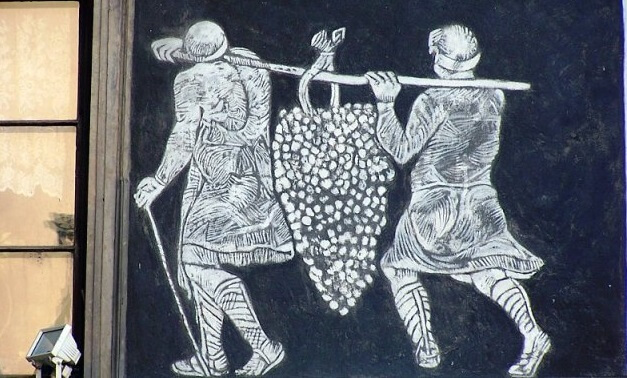
One of the greatest tragedies in the long history of the Jewish people occurred when the spies sent by Moses returned with a frightening report about the Land of Israel. Their dire warnings of fierce giants and a “land that consumes its inhabitants” convinced the people that they would be better off returning to Egypt.
Unlike other incidents in which the Israelites rebelled against God, on this occasion, Moses was unable to annul God’s decree. The entire generation died in the desert, never reaching the Promised Land. The best Moses was able to do was delay the punishment for forty years.
Rav Kook wrote that even today we still suffer the consequences of this catastrophic error. The root cause for the exiles and humiliations of the Jewish people, throughout the generations, is due to our failure to correct the sin of the spies.
How can we rectify the sin of the spies?
To repair this national failure, a teshuvat hamishkal is needed, a penance commensurate with the sin which will “balance the scales.” The spies defamed the Land of Israel, as it says, “They despised the desirable land” (Psalms 106:24). We must do the opposite and show our unwavering love for the Land.
[We must] declare to the entire world [the Land’s] magnificence and beauty, its holiness and grandeur. If only we could express (with what may appear to us to be greatly exaggerated) even a ten-thousandth of the desirability of the beloved Land, the splendorous light of its Torah, and the superior light of its wisdom and prophecy!
The quality of wonderful holiness that Torah scholars seeking holiness may find in the Land of Israel does not exist at all outside the Land. I myself can attest to this unique quality, to a degree commensurate with my meager worth. (Iggerot HaRe’iyah, vol. I, pp. 112-113)
For Rav Kook, this recommendation on how to address the sin of the spies was not just a nice homily. Stories abound of his burning love for the Land of Israel and his indefatigable attempts to encourage fellow Jews to move to Eretz Yisrael.
Kissing the Rocks of Acre
The Talmud in Ketubot 112a records that Rabbi Abba would demonstrate his great love for the Land of Israel by kissing the rocks of Acre as he returned to Israel. What was so special about these rocks?
Rav Kook explained that if Rabbi Abba had bent down and kissed the soil of Eretz Yisrael, we would understand that his love for the Land was based on the special mitzvot that are fulfilled with its fruit — tithes, first fruits, the Sabbatical year, and so on. The soil, which produces fruit, signifies the importance and holiness of the Land through the mitzvot hateluyot ba’aretz.
But Rabbi Abba’s love for the Land was not dependent on any external factors — not even the Land’s special mitzvot (see Avot 5:16; Orot, p. 9). Rabbi Abba cherished the intrinsic holiness of Eretz Yisrael. He recognized that the special qualities of the Land of Israel, such as its receptivity to prophecy and enlightenment, go far beyond those mitzvot connected to agriculture. Therefore, he made a point of kissing its barren rocks and stones.
‘God Willing’
During a 1924 fundraising mission in America, Rav Kook tried to convince a wealthy Jew to immigrate to Eretz Yisrael. The man gave various reasons why he could not yet leave America, but concluded, “God willing, I too will soon make Aliyah to Israel.”
Rav Kook responded: “God is certainly willing. After all, settling Eretz Yisrael is one of His commandments. But you must also be willing...”
Without Calculations
Once, a Jewish tourist visited Rav Kook in Jerusalem, seeking advice as to the possibility of living in Eretz Yisrael. During the discussion, the visitor calculated the pros and cons of moving to Israel; and in the end, he decided that it was not worthwhile.
Rav Kook told the man:
Before the Israelites entered the Land in the time of Moses, they first needed to kill Sichon, the king of Heshbon. This teaches us that one should come to the Land of Israel bli heshbon — without making calculations.
(Sapphire from the Land of Israel. Adapted from Malachim Kivnei Adam, pp. 221, 222, 237.)
Illustration image: Peace Square in Litoměřice, Czech Republic. Spies Returning from the Promised Land (2006).