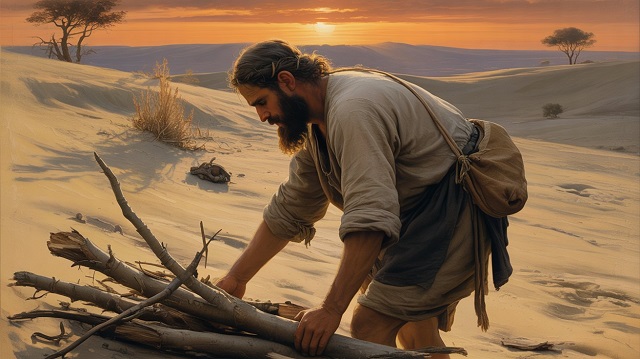
Our father died in the desert... He died because of his own sin, and he had no sons. (Num. 27:3)
So begins the request of the daughters of Tzelofchad. Since there were no sons in the family, the daughters wanted to know: may we inherit his portion in the Land of Israel? Their question stumped Moses, and was referred to God Himself.
The Torah doesn’t tell us, but we are curious nonetheless: what was the sin for which Tzelofchad deserved to die? The text seems to imply that his transgression was an unusual one: “He died because of his own sin.”
In the reading of Shelach it says:
The Israelites were in the desert, and they found a man collecting wood on the Sabbath. (Num. 15:32)
Interesting. Again, we find the phrase, “in the desert.” (And quite superfluous, considering that the entire book takes place in the desert.) Once again, Moses is stumped, and needs to ask God what is the appropriate punishment. Who was this unidentified man, the wood-gatherer who desecrated the Sabbath?
It was Rabbi Akiva who made the connection between the man with the unknown sin, and the sin of the unknown man. Tzelofchad was the Sabbath wood-gatherer. That was his personal transgression, for which he was punished (Shabbat 96b).
Is there a connection between Tzelofchad’s desecration of the Sabbath, and the fact that he died without sons, thus jeopardizing his inheritance in the Land of Israel? Also, why does the Torah emphasize that his sin took place “in the desert”?
Trapped in the Desert
The desert represents transience. A desert is not a place that can be settled and cultivated. We only pass through the desert as we make our way to a permanent location, to our true destination. Life in the desert is transient; it is only a preparation and a means towards a desired objective.
Even the holiness in the desert was temporary. Mount Sinai was sanctified solely for the sake of the Torah’s revelation; afterwards, the mountain reverted to its previous state. Permanent holiness only exists in the Land of Israel and the city of Jerusalem.
Sanctity within the dimension of time — as in space — may also have varying degrees of permanence. The most eternal holiness in time is the holiness of the Sabbath. “The Israelites will observe the Sabbath, making it a day of rest for all generations, an eternal covenant” (Ex. 31:16).
Unlike the Sabbath, which falls out every seventh day, the holidays are dependent upon the calendar, as set by the high court. The sanctity of the holidays is thus of a less eternal nature. Additionally, the holidays relate to historical events: the Exodus from Egypt, the journey in the desert, the Revelation of the Torah. The Sabbath, on the other hand, transcends the realm of mankind. It celebrates the very essence of creation.
Tzelofchad’s sin took place in the desert, and he died in the desert. When Tzelofchad desecrated the eternal sanctity of the Sabbath, he transformed the desert from a passageway into a dead-end. He became disconnected from eternal holiness, both in time and space. He lacked permanence and continuity in the dimension of time — the Sabbath day — and in the dimension of space — his inheritance in the Land of Israel.
We should learn from Tzelofchad’s mistake, and avoid being locked within the temporal realm of the desert. We need to stay focused on that which is enduring and eternal, and not confuse the way-station for the final destination.
(Gold from the Land of Israel, pp. 243-245. Adapted from Ein Eyah vol. IV, p.238)