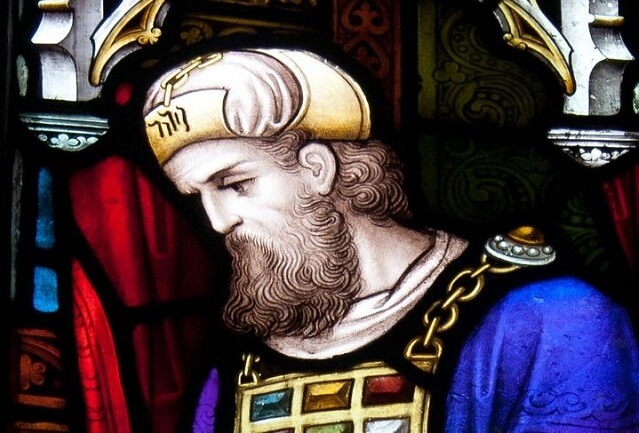
After the tragic deaths of Aaron’s sons Nadav and Avihu, Moses instructed Aaron and his remaining sons not to display any public signs of mourning:
Do not let your hair grow untended, and do not rend your garments.... And as far as your brothers are concerned, the entire house of Israel will mourn the ones whom God has burned. (Lev. 10:6)
Why was Aaron not allowed to publicly mourn the death of his sons?
The Death of Rabbi Yehudah HaNasi
To better understand Moses’ unusual instructions, we must examine the Talmudic account of the passing of another prominent individual: Rabbi Yehudah HaNasi (‘the Prince'). Rabbi Yehudah HaNasi was the second-century redactor of the Mishnah, and a pivotal religious and political figure. His influence was so great that he was universally referred to as Rebbi — “my teacher.” No other name was needed to identify him.
Rabbi Yehudah’s death was a traumatic event for the entire nation. The Talmud in Ketubot 104a relates the story of his final hours:
When Rebbi became deathly ill, the scholars declared a public fast. His students and colleagues prayed for his recovery.
Rebbi’s maidservant went up to the roof and pleaded: “On high, the [angels] want Rebbi [to join them]; and down below, they want Rebbi [to stay]. May it be Your will that those down below should prevail.” But when she saw that Rebbi was suffering, she changed her prayer: “May it be Your will that those above will prevail.”The scholars however continued their constant prayers for Rebbi’s recovery. The maidservant grabbed a jar and hurled it from the roof. The sudden crash startled the scholars and momentarily disrupted their prayers. Rebbi’s soul promptly departed.
The sages asked Bar Kappara to investigate. He went and found Rebbi had passed away. Bar Kappara tore his garment and reported back:
“The angels and the mortals struggled over the Holy Ark. But the angels vanquished the mortals, and the Holy Ark has been captured.”
Why did the scholars and the maidservant disagree over whether to pray for Rabbi Yehudah HaNasi to live? Who was right? And why did Bar Kappara refer to his illustrious teacher as “the Holy Ark”?
The Benefits of Tzaddikim
The key to understanding this account is recognizing that there are two ways in which Torah scholars benefit the world. The first contribution is obvious to all: they disseminate Torah and provide guidance in the proper path.
In addition to these activities, however, there is an intrinsic quality based on the inner holiness of the Torah itself. Tzaddikim provide a hidden benefit, as they refine and elevate society by their very presence.
The Talmud in Sanhedrin 99b teaches that one who complains, “What do Torah scholars do for society? They only study for themselves” should be considered a heretic. Even if we do not see how scholars contribute to society, the intrinsic holiness of their Torah provides blessing and merit for all. Even the evil city of Sodom would have been spared had ten righteous people lived there, as God informed Abraham: “I will spare the entire region for their sake” (Gen. 18:26).
Bar Kappara’s Message
Now we may understand the story of Rabbi Yehudah HaNasi’s death, and the disagreement between his disciples and his maidservant.
There are instances when it is proper to pray for the release of those gravely ill — when they are suffering greatly and there is no hope for their recovery (see Nedarim 40a). This, however, does not apply to a tzaddik. With regard to Torah scholars, the very existence of their Torah in the world is a hidden treasure that outweighs considerations of their own personal pain and discomfort. For these righteous individuals, it is proper to pray even for chayei sha’ah, for a limited extension of life. For this reason, the scholars continued praying for Rebbi, even though his illness was terminal.
At first, Rebbi’s maidservant also prayed for his recovery, but her motivation was that her master should be able to continue to disseminate Torah. When she realized that his illness was so grave that he would no longer be able to teach, and that the only possible gain prayer could achieve was a temporary reprieve from death, she decided — mistakenly — that Rebbi no longer served a purpose in this world. Since he could no longer benefit this world and was wanted in the next, she prayed that the angels and the righteous souls in the next world would prevail.
Bar Kappara, however, recognized Rebbi’s lofty inner qualities and his hidden benefit to the world. For this reason he referred to his teacher as “the Holy Ark.” Bar Kappara wanted the people to recognize that this inner holiness was in fact Rebbi’s primary benefit to the world. In this aspect, a tzaddik is like the Holy Ark. The Ark contained the original luchot (tablets) from Mount Sinai, and was a symbol for the Torah. Yet the Ark was covered with a heavy plate of gold; it was impossible to actually study from the luchot within. Thus the Holy Ark represents, not the Torah’s practical benefit to the world, but its intrinsic holiness. From its location in the Temple’s inner sanctum, it emanated holiness to the nation and the entire world.
We must appreciate Rebbi, Bar Kappara was saying, not just as the redactor of the Mishnah and a teacher of Torah, but primarily as a Holy Ark, as a receptacle of Torah and holiness.
Mourning for Nadav and Avihu
Now we can understand why Aaron and his family were not permitted to publicly mourn for Nadav and Avihu. The benefit that the inner holiness of tzaddikim provides to the world is so great that it cannot be expressed in words. External displays of mourning cannot do justice to the magnitude of this loss. Public signs of mourning only express our sorrow at the cessation of their public activities.
Since the people were unable to truly appreciate the inner qualities of Nadav and Avihu, it was appropriate for the nation to publicly mourn the loss of their outward contributions to society. But Aaron, who recognized the lofty nature of his sons, realized that this terrible loss could never be conveyed in human language. Thus “Aaron was silent” (Lev. 10:3).
Moses instructed Aaron not to eulogize his sons even for their public activities, because this was a minor benefit comp ared to the value of their inner holiness. Since this hidden quality cannot be expressed in words, it was preferable for Aaron to remain silent.
Often we eulogize a great individual so that people will come to recognize the magnitude of the loss to society. In this instance, however, Moses explained that public mourning was unnecessary. Even without public eulogies, “The entire house of Israel will mourn the ones whom God has burned.” The entire nation was aware of Nadav and Avihu’s greatness, and would surely lament their absence.
(Sapphire from the Land of Israel. Adapted from Midbar Shur, pp. 332-336, 341-342)