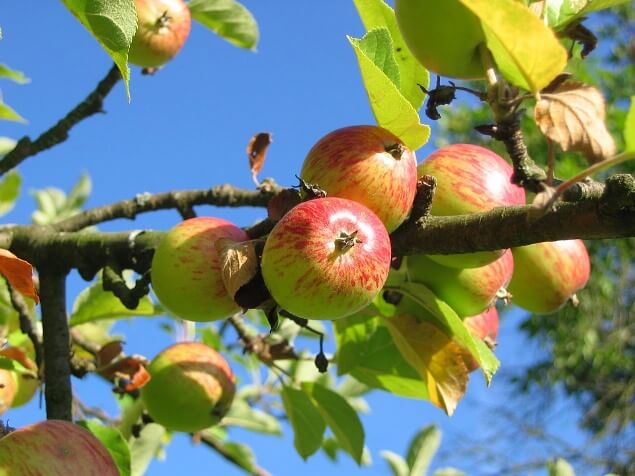
The Midrash compares the Jewish people at Mount Sinai to an apple tree. In what way?
Like an apple tree among the trees of the wood, so is my beloved among the sons (Song 2:3). Why is Israel compared to an apple tree? An apple tree sends forth its fruit before its leaves. So too, Israel promised Na’aseh (‘We will do’) before Nishma (‘we will understand'). (Shabbat 88a)
The Song of Songs — the poetic love-story of a shepherdess and her
beloved — is traditionally understood as a parable for the relationship between
the Jewish people (the shepherdess) and God. This
Midrash, however, interprets the story in a different fashion, as a
parable for the special connection
of the Torah and the people of Israel. According to this
interpretation, the shepherdess is the Torah, which yearns
for the holiness found in the souls of Jewish people.
Still, the comparison to an apple tree is not clear. Why it is important that the people first said at Sinai, Na’aseh, “We will do”? How does this relate to the fact that certain species of apple trees produce fruit-buds before the leaves?
Two Revelations — Oral and Written
A careful reading of the Torah’s description of Matan Torah reveals that Moses presented the Torah to the people not once but twice:
Moses came and told the people all of God’s words and all the statutes. All the people answered in one voice, saying: ‘All the words that God spoke — we will do.’ (Ex. 24:3)
Moses wrote all of God’s words ... He took the book of the covenant and read it to the people. And they said, ‘All that God spoke, we will do and we will understand.’ (Ex. 24:4-7)
In other words, Moses transmitted the Torah both orally and in writing. Why was this necessary? And why did the people respond "we will do” the first time, while at the second revelation they added, "and we will understand"?
The Challenge of Sinai
Matan Torah presented a major challenge. On the one hand, the Torah was to be presented in a way that the entire people would gain a personal connection to its Divine message. At the same time, it was critical to avoid the dangers of distorted interpretations due to the superficial study of unlearned masses. To address this concern, two Torahs were transmitted at Sinai: the Oral Torah and the Written Torah.
The primary goal of Torah is that we should know how God expects us to act in the world. This is the purpose of the extensive literature of the Oral Law, the Mishnah and Talmud, which analyzes in detail our moral and spiritual obligations in life’s varied (and often complex) situations.
Additionally, there is a second aspect of Torah: knowing the Torah for its own sake. This is the function of the Written Torah. The Sages wrote that even one who does not understand the words he reads fulfills the mitzvah of Torah study (Shir HaShirim Rabbah 2:4). This, however, is only true for the Written Torah. Studying the Oral Torah has no value if it is not understood correctly. On the contrary, misunderstanding the Oral Law can lead to erroneous actions.
To acquire a clear grasp of the Torah’s teachings on a practical level requires a breadth and depth of Torah scholarship. An entire people cannot be expected to attain such a level of Torah knowledge. For this reason, the practical side of Torah was transmitted orally. This way, only those willing to toil in its study and learn from great scholars can acquire its knowledge. If this part of Torah were written down and revealed to all, even the unlearned would feel qualified to decide practical issues. An oral transmission ensures that those rending decisions will be dedicated scholars who study Torah thoroughly and diligently.
One might argue that perhaps the entire Torah should be transmitted orally. But were this the case, Torah knowledge would be limited to a select few. The Written Law enables all to approach the Torah on whatever level they are capable of understanding.
In summary: it was important that the Jewish people accept both forms of Torah at Sinai, both written and oral. This ensured that the entire people would be connected to Torah while relying on qualified scholars to render legal decisions.
Na’aseh and then Nishma
It is natural for people to seek to understand as much as possible and act according to their understanding. We would expect that the Jewish people would demand to receive the entire Torah in a written form, so that they would have access to all aspects of Torah.
The spiritual greatness of the Jewish people at Mount Sinai was their recognition of the advantage of not writing down the Oral Law, so that their actions would be determined by true scholars and thus best fulfill God’s Will. This is the significance of their promise, 'Na’aseh': we will act according to the teachings and instructions of the sages. Since this acceptance was equally relevant to all, regardless of intellectual capabilities and education, the verse emphasizes that "All the people answered in one voice.”
Having accepted upon themselves to properly keep the Torah according to the dictates of the sages, Moses then presented the people with the Written Torah. We would have expected that the people would have demonstrated their love for the Written Law — since this was a Torah they could access directly — by immediately stating, 'Nishma!' — "we will understand.” But once again, the Jewish people demonstrated their desire to first fulfill the practical side of Torah. They announced: "We will do,” and only afterwards, "we will understand.”
The Fruit and the Leaves
Now we may understand better the comparison to an apple tree. Fruit requires sunlight to grow and ripen. Too much exposure to the sun, however, may cause the fruit to dry up and shrivel. This is where the leaves come in — to protect the fruit so they will receive the right amount of sunlight.
The ultimate goal is, of course, the fruit. With Torah, the goal is the proper action, which is achieved through the Oral Torah. The Written Law, on the other hand, is like the leaves. Just as the leaves protect the fruit, so too, the more accessible Written Torah prepares each soul to receive the light of the Oral Torah. In order that the people will accept the Torah and understand the importance of keeping its mitzvot, the entire people needed to be exposed to the Written Torah. Through this direct connection to Torah, they were ready to accept the instruction of the Oral Torah as taught by the great Torah scholars of each generation.
The apple tree produces fruit-buds before the leaves, since at first the fruit requires direct sunlight. So too, the people first accepted the Oral Law, the detailed Torah given to the sages to interpret, like the sunlight that ripens the fruit.
However, without a direct connection to Torah, the people would eventually come to reject it. Therefore Moses subsequently presented the Written Law, to protect the Oral Law for future generations. The order at Sinai — first the Oral Law and then the Written Law, first Na’aseh and then Nishma — thus parallels the development of the apple tree — first the fruit-buds, and then the leaves.
(Adapted from Midbar Shur, pp. 160-165)