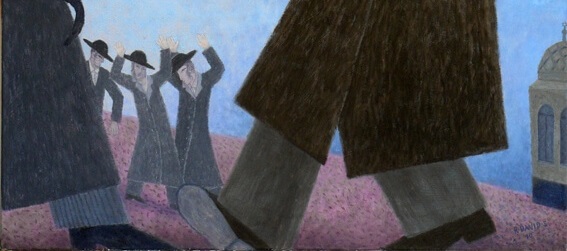
In this chapter, the psalmist expresses confidence that his path is straight and his deeds are pure. The psalm concludes,
רַגְלִי עָמְדָה בְמִישׁוֹר, בְּמַקְהֵלִים אֲבָרֵךְ ה'. (תהילים כו:יב)
My leg stands on a straight path. In assemblies I will bless God. (Psalms 26:12)
But why speak of a single leg? Would it not be better to have both feet planted firmly on the ground?
Spiritual Legs
Physically, we advance forward by means of our legs. Also spiritually, we advance using two “spiritual legs.” What are they?
The first leg is the merit of our good deeds. And the second leg is our connection to the klal, the community and the nation. Together, these two ‘legs’ enable us to maintain our ethical equilibrium and advance spiritually.
Which leg is more crucial? True growth, of course, requires one to be accomplished both in good deeds and in one’s connection to the klal. But if we need to choose, which quality is more important?
Torah On One Leg
This question was posed to Hillel over two thousand years ago. A potential convert challenged the first-century scholar to teach him the entire Torah “on one leg.” Once again, the metaphor of a single leg.
The gentile was not trying to be annoying. He wanted to know: What is the single most fundamental quality of the Torah? Hillel responded, “What is hateful to you, do not do to your neighbor” (Shabbat 31a). In other words, the Torah is based on correct interpersonal relations. The Torah is upheld by one’s connection to society. By being part of the klal, one is rooted within the framework of a faith-community.
Out of modesty, King David spoke of a single leg: “My leg stands on a straight path.” He did not claim complete mastery in good works. Only one of my spiritual legs is complete, David declared, and that is my connection to the klal. With all my heart, I cleave to the nation. I have unbounded love for each and every Jew. My second leg, my reserve of good deeds, may be lacking; but since my first leg is sturdy, I am able to stand firmly on the straight path.
Now we can understand the connection to the second half of the verse, which describes the spiritual benefit of belonging to a community: “In assemblies, I will bless God.”
This idea appears to be the primary theme of the chapter. The psalmist avoids the negative influences of deceitful people and “gatherings of evildoers.” Instead,
אָהַבְתִּי מְעוֹן בֵּיתֶךָ, וּמְקוֹם מִשְׁכַּן כְּבוֹדֶךָ
He takes inspiration from “the abode of Your house and the place where Your glory dwells” (Ps. 26:8). In this way, he merits to publicly bless God, “in the assemblies” of his people.
(Adapted from Midbar Shur p. 73.)