The psalmist offers a surprising comparison between the prophet Samuel and the greatest leaders of the Jewish people, Moses and Aaron:
“מֹשֶׁה וְאַהֲרֹן בְּכֹהֲנָיו, וּשְׁמוּאֵל בְּקֹרְאֵי שְׁמוֹ; קֹרִאים אֶל-ה', וְהוּא יַעֲנֵם.”
(תהילים צ"ט:ו)
“Moses and Aaron among His priests, and Samuel among those who invoke His name — they called out to God, and He answered them. (Psalms 99:6).
This verse appears to put Samuel on equal footing with Moses and Aaron. With all due respect to Samuel’s greatness, can he truly be compared to Moses, about whom the Torah testifies, “No other prophet like Moses has arisen in Israel” (Deut. 34:10)?
And yet, the Sages taught that Samuel was in fact “the equal of Moses and Aaron” (Berachot 31b). How can this be?
Two Motivations of Observance
People commonly find value in observing Torah and mitzvot, not in terms of their intrinsic worth, but as a way to acquire a content, balanced lifestyle. “Its ways are pleasant ways, and all its paths are peace” (Prov. 3:17). An individual — and a society — following in the path of Torah will live a life of peace and tranquility. Individuals who are genuinely religious do not lose themselves in anger or pride; they abstain from lying and cheating, and take care to respect others.
However, an innate love of God smolders in every heart. When we are filled with a lofty spirit of pure love, we are inspired to serve God. Tzaddikim are constantly motivated by this altruistic devotion. But for most people, these are special moments, spiritual highlights. During most of their lives, they need to be encouraged to observe mitzvot, and this happens when they are exposed to the Torah’s beautiful ways and practical benefits.
Two Types of Leaders
Moses and Aaron were both extraordinary leaders, but they guided the Jewish people in significantly different ways. Moses needed to be on a high spiritual level at all times, one suitable for receiving prophecy. His mission was to instruct the people in the proper path. To accomplish this goal, Moses lived his life removed from the worldly concerns of the common man.
Aaron, on the other hand, “loved peace and pursued peace” (Avot 1:12). He was part of society, involved with the people and their problems. Aaron brought the Torah down to their level, demonstrating its beauty in a way they could appreciate.
Moses and Aaron were thus very different types of leaders. Moses taught the intrinsic value of Torah according to its absolute truth. The Sages described Moses’ approach of unyielding authenticity with the phrase, “Let the Law pierce the mountain” (Sanhedrin 6b).
This absolute truth is appreciated by tzaddikim at all times, and by the rest of the people at inspired moments. Aaron’s task was to promote receptivity to these special moments, as he encouraged the people to elevate their daily lives.
Samuel’s Leadership
And what about Samuel? During his tenure as leader and judge, he performed both of these roles. A prophet like Moses, he spread the spirit of altruistic service of God among the spiritual elite, and for the masses at inspired times. And like Aaron, Samuel strengthened Torah observance throughout society, teaching the Torah’s pleasant paths and demonstrating how mitzvot beautify and ennoble life.
Thus, in his leadership style, Samuel was “the equal of both Moses and Aaron.”
(Adapted from Olat Re’iyah vol. II, pp. 18-19)
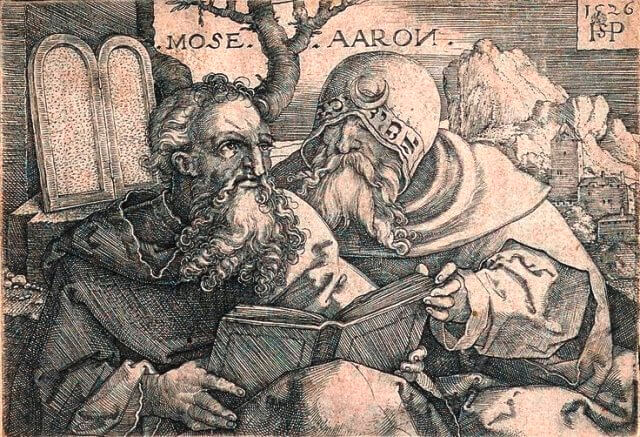
Illustration image: Moses and Aaron (1526, artist unknown)