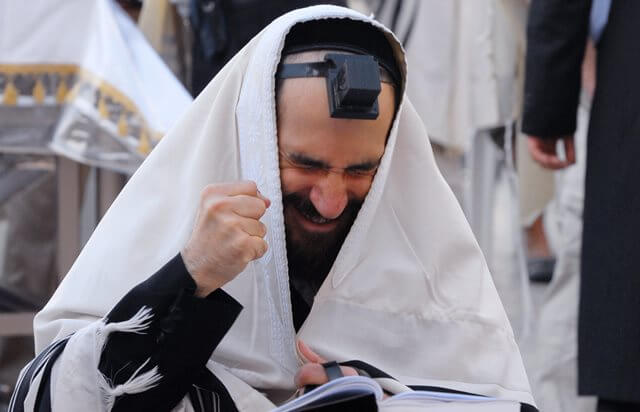
What motivates a person to live a life of Torah?
Some people are drawn to Torah for pragmatic reasons. They seek a more balanced lifestyle, stronger family ties, a warmer community, a kinder society.
Others are motivated by spiritual aspirations. They seek a life of holiness and meaning; they strive for greater closeness to God.
Which path is preferable?
Shema and Prayer
Rabbi Elazar taught that Psalm 63 alludes to both paths:
כֵּן אֲבָרֶכְךָ בְחַיָּי,
בְּשִׁמְךָ אֶשָּׂא כַפָּי...
וְשִׂפְתֵי רְנָנוֹת, יְהַלֶּל-פִּי
(תהילים סג)
“So I will bless You in my life. In Your name, I will lift up my hands... My mouth will give praise with songs of joy.” (Psalms 63:5-6)
Rabbi Elazar said: What does this mean?
“I will bless You in my life” — this refers to reciting the Shema.
“In Your name, I will lift up my hands” — this refers to prayer.
And those who do this... inherit two worlds, this world and the next. As it says, “My mouth will give praise with songs of joy.” [The verse speaks of two songs — one in this world, and one in the next.] (Berakhot 16b).
In what way is this verse connected to Shema and prayer? And what does it mean to “inherit two worlds”?
A Life that Blesses God
If we examine the verses of the Shema, we see that they speak of a better life in this world. If we follow the Torah’s teachings, we will merit a good life, rains of blessing, and plentiful crops. And if not, we will suffer hardship and exile.
Rabbi Elazar taught that the Shema corresponds to the phrase, “I will bless You in my life.” When we are guided by a higher goal, when our actions reflect the Torah’s demands for morality and rectitude, then our lives in this world bless God. “In my life, I will bless God.” This is the fundamental message of Shema: accepting the Torah’s authority and living our lives according to its ethical teachings.
However, we should also strive for higher aspirations, beyond improving the physical world. We should also reach out for spiritual goals. That is the realm of tefillah and prayer.
Higher Aspirations
In prayer, we aspire to goals that go beyond repairing this world. When we pray, we stand straight like the angels. We beseech God for spiritual gifts: enlightenment and redemption, the return of the Shechinah, the means to discover our spiritual path.
We gain awareness of the priceless nature of life when it matches ratzon Hashem, God’s Divine Will that supersedes all other goals and aspirations. Our actions acquire a deeper significance when we recognize the greatness of their purpose.
This is how Rabbi Elazar understood the second half of the verse. “In Your name” — when I internalize a deeper awareness of God’s Name and Will — “I will lift up my hands.” My hands, my strength and power, are uplifted. This outlook awakens a greater appreciation for life, as our lives are elevated beyond the concerns of the physical world.
Inheriting Two Worlds
If we can absorb the inner content of both Shema and prayer, so that God’s Will gives direction to both our physical lives and our higher aspirations, then our service of God will be transformed into one of joy and meaning. It will no longer be necessary to subdue our physical inclinations. “As with the richest foods, my soul will be sated” (Psalms 63:6). We will feel tremendous joy and satisfaction in our service of God.
The ultimate reward is to “inherit two worlds,” to live an elevated existence in both the physical and spiritual realms. “I will bless You in my life” — we live a life of blessing in this world when we accept God’s Will. And “In Your name, I will lift up my hands” — when we elevate ourselves beyond our worldly existence, and reach out for the spiritual reality of the future world.
Then we will “give praise with songs of joy”. We will sing two songs of joy — a song of this world, and a song of the next.
(Adapted from Ein Eyah vol. I, II:19)