We usually speak of the heart rejoicing and praising God. “My heart and my flesh sing out to the living God” (Ps. 84:3). Yet we find the psalmist also speaks of his bones exclaiming God’s praise:
All of my bones will say, ‘God, Who is like You?’ (Ps. 35:10)
Can bones praise God?
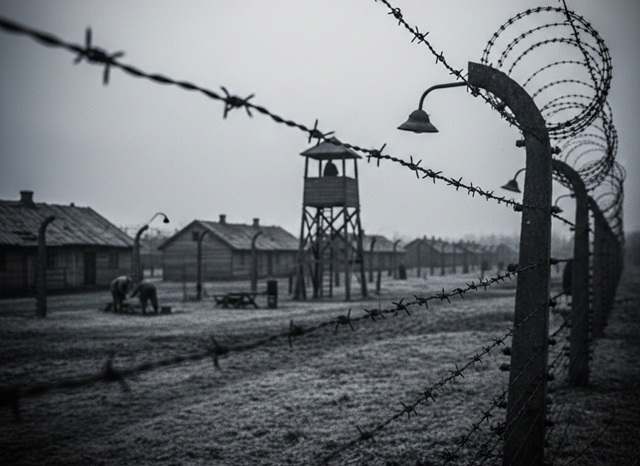
Yom Kippur in the Janowska Road Camp
“This particular story is one of those stories that deserves to be published in a book,” said the Rebbi of Bluzhov, Rabbi Israel Spiro.
In the Janowska camp there was a Jewish foreman from Lvov by the name of Schneeweiss, one of those people to avoid if you value your life.
Yom Kippur was nearing and fears in the camp mounted; everyone knew that the Germans especially liked to use Jewish holidays as days for inflicting terror and death. Nevertheless, a group of Hasidim asked the Rabbi of Bluzhov to approach Schneeweiss and request that on Yom Kippur his group not be assigned to any of the thirty-nine main categories of work, so that their transgression of the law by working on Yom Kippur would not be a major one.
The rabbi knew that the foreman had little respect for Jewish tradition. Before the war, Schneeweiss had publicly violated the Jewish holidays, and in Janowska, he was a merciless man. Despite his fears, the rabbi agreed to speak with him.
“You probably remember me. I am the Rabbi of Pruchnik, Rabbi Israel Spira.” Schneeweiss did not respond. “Tonight is Kol Nidrei night,” the rabbi continued. “There is a small group of Jews who do not want to transgress any of the major prohibitions of the day. It means everything to them. It is the essence of their existence. Can you do something about it? Can you help?”
The rabbi noticed a hidden shiver went through Schneeweiss. He took his hand and said, “I beg you to do this for us so that we may still find some dignity in our humiliating existence.”
The stern face of Schneeweiss changed. For the first time, the rabbi saw in it a human spark. “Tonight I cannot help you,” Schneeweiss replied. “But tomorrow, on Yom Kippur, I will do whatever I can.”
Even the Transgressors in Israel
The following day, the rabbi and a small group of young Hasidim were summoned to the foreman’s cottage. He arranged for them to clean in a way that would not transgress any of the thirty-nine major categories of work.
The rabbi was standing on a ladder with rags in his hand, cleaning the huge windows while chanting prayers, and his companions were on the floor polishing the wood and praying with him. “The floor was wet with our tears. You can imagine the prayers of that Yom Kippur...”
At about twelve o'clock noon, the door opened wide. Into the room stormed two angels of death, S. S. men in their black uniforms. They were followed by a food cart filled to capacity. The room was filled with the aroma of freshly cooked food, such as they had not seen since the German occupation: white bread, steaming hot vegetable soup, and huge portions of meat.
The tall S. S. soldier commanded, “You must eat immediately or you will be shot on the spot!” No one moved. The rabbi and the Hasidim remained in their places. The German repeated the orders. The Jews remained glued to their places. The S.S. men called in Schneeweiss. “Schneeweiss, if the dirty dogs refuse to eat, I will kill you along with them!”
Schneeweiss pulled himself to attention, looked the German directly in the eyes, and said in a quiet tone, “We Jews do not eat today. Today is Yom Kippur, our most holy day, the Day of Atonement.”
“You don’t understand, Jewish dog,” roared the tall soldier. “I command you in the name of the Fuhrer and the Third Reich — fress!”
Schneeweiss, composed, his head high, repeated the same answer. “We Jews obey the law of our tradition. Today is Yom Kippur, a day of fasting.”
The German took out his revolver from its holster and pointed it at Schneeweiss’s temple. Schneeweiss remained calm. He stood still, at attention, his head high. A shot pierced the room. Schneeweiss fell.
The rabbi and the Hasidim remained frozen in their places, not believing what their eyes had just witnessed. Schneeweiss, the man who in the past had publicly transgressed against Jewish tradition, had sanctified God’s Name publicly and died a martyr’s death for the sake of Jewish honor.
“Only then, on that Yom Kippur day in Janowska,” said the rabbi, “did I understand the meaning of the statement in the Talmud: “Even the transgressors in Israel are as full of good deeds as a pomegranate is filled with seeds” (Berakhot 57a).”
Even the Bones
There are inner powers of the soul that are ordinarily not felt. They are only awakened at special times, in times of need. These powers may be compared to our bones. Unlike the flesh, which is more sensitive, our bones do not seem to be so ‘alive.’
Nonetheless, bones are a basic part of our bodies. They break when we are injured, and they mend when we are healed.
When we sanctify our soul, we reveal our hidden light. And all of our inner powers are revealed — even those spiritual resources that are usually hidden. This then is the intent of the verse. Deep down, even our bones, even our hidden powers, will express our wonder, ‘God, who is like You?’
(Adapted from Olat Re’iyah vol. II, p. 97. Story condensed from ‘Hasidic Tales of the Holocaust’ by Jaffa Eliach, pp. 180-184.)