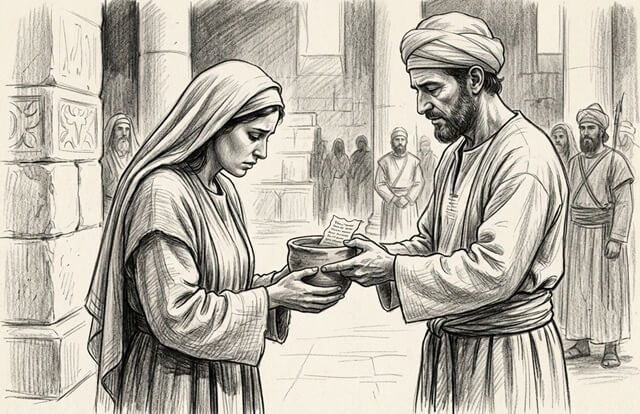
The Suspected Adulteress
The first ten chapters of the book of Numbers discuss the organization of the Israelites in the desert. The census, the placement of camps according to tribe, the duties of the Levites, the dedication of the Tabernacle, the inauguration of the Levites — all of these topics pertain to the preparatory arrangements needed to organize the journey of millions in the wilderness.
Yet, in the middle of all of these rather technical subjects, the Torah discusses the Sotah, the suspected adulteress. What does this unfortunate story of distrust and jealousy have to do with organizing the Israelites in the desert? This topic would more naturally belong in the section on forbidden relations in Acharei Mot (Lev. chapter 18).
This anomaly did not escape the Talmudic sages. Rabbi Yochanan noted that the verses immediately preceding the section on Sotah discuss the tithes given to the kohanim.
Why does the subject of the suspected adulteress immediately follow the laws of offerings and tithes for the kohanim? To teach that whoever does not hand over his tithes to the kohen, will in the end require the kohen’s services to deal with his wife. (Berakhot 63a)
What is the connection between withholding tithes and a wife’s suspected infidelity?
Alienation from the Kohanim
It is vital that the masses maintain a strong connection with those dedicated to the service of God and the study of Torah, like the kohanim, about whom it is written (Malachi 2:7), "From the kohen’s lips they will guard knowledge, and they will seek Torah from his mouth.” This bond is crucial for the ethical instruction of the people, enabling the Torah’s teachings to reach the entire nation. Scholars are uplifted as they study Torah and analyze its wisdom, and the rest of the people are influenced through their relationship with those who study and disseminate Torah and its ethical teachings.
What is the vehicle for ensuring this connection between the people and the spiritual elite? It is through the various gifts and tithes that the Torah designated to the kohanim.
An individual who cuts himself off from the spiritual leadership is likely to undergo a deterioration in his moral values and spiritual sensitivity. As a result of his overriding occupation with the material world and estrangement from Torah and all that is holy, the moral level of his household will decline to such an extent that even the most basic human values — modesty and fidelity — will be seriously undermined.
This spiritual collapse will necessitate the assistance of the kohen because of his wife’s suspect behavior. When the moral decline is so great that even his simple soul is appalled by the shocking decadence in his family-life, he will realize how wrong he was to distance himself from the kohanim and Torah scholars.
A Nation Gone Astray
This deplorable phenomenon may also occur on the national level. When the pursuit of material pleasures causes large sectors to cast off the Torah and its teachings, they will distance themselves from Torah scholars and deem them superfluous. They may even come to despise and ridicule them.
At this point, a plague of immorality and corruption will spread among the people. The situation will continue to deteriorate, until those individuals who still retain some spark of humanity and a feeling for the light of Torah will weep with broken hearts. They will painfully recognize that their lives have become debased and bleak by rejecting the ways of Torah. Their separation from Torah brought about such a wild, unbridled national spirit, that the nation is derided and mocked by other peoples.
They brought this affliction upon themselves, however, with their scorn for Torah scholars and contempt for all that is holy. The people, once famous for integrity and modesty, will require the services of the holy kohanim in order to repair the collapse of fidelity and trust.
(Gold from the Land of Israel. Adapted from Ein Eyah vol. II, pp. 381-382)