The Talmud (Berakhot 10b) tells a puzzling story about the righteous king Hezekiah. It is related that the king secreted away the medical books of his day. Why? King Hezekiah felt that the people relied too heavily on the prescriptions described in those texts, and did not pray to God to heal them.
Surprisingly, the Sages approved of King Hezekiah’s action. Such an approach would appear to contradict another Talmudic ruling. The Torah says one who injures his neighbor must “provide for his complete healing” (Exodus 21:19). The Talmud (Baba Kama 85a) deducts from here that the Torah granted doctors permission to heal. Even with natural diseases, we do not say, “Since God made him ill, it is up to God to heal him,” but do our best to heal him.
Which is the correct attitude? Should we rely on doctors and medical books, or place our trust only in God and prayer?
There is in fact a larger question at stake. When are we expected to do our utmost to remedy the situation ourselves, and when should we rely on God’s help?
Two Forms of Bitachon
Rav Kook explained that there are two forms of bitachon, reliance on God. There is the normative level of trust, that God will assist us in our efforts to help ourselves. And there is the simple trust in God that He will perform a miracle, when appropriate.
Regarding the community as a whole, we find apparent contradictions in the Torah’s expectations. Sometimes we are expected to make every possible effort to succeed, as in the battle of HaAi (Joshua 8). On other occasions, human effort was considered a demonstration of lack of faith, as when God instructed Gideon not to send too many soldiers to fight, “Lest Israel should proudly say ‘My own hand saved me'” (Judges 7:2). Why did God limit Gideon’s military efforts, but not Joshua’s in the capture of HaAi?
The answer is that the spiritual level of the people determines what level of bitachon is appropriate. When we are able to recognize God’s hand in the natural course of events, when we are aware that God is the source of our strength and skill — “Remember the Lord your God, for it is He Who gives you strength to succeed” (Deut. 8:18) — then God is more clearly revealed when He supplies our needs within the framework of the natural world. In this situation, we are expected to utilize all of our energy and knowledge and talents, and recognize divine assistance in our efforts. This reflects the spiritual level of the people in the time of Joshua.
On the other hand, there are times when the people are incapable of seeing God’s help in natural events, and they attribute any success solely to their own efforts and skills. They are likely to claim, “My own hand saved me.” In this case, only miraculous intervention will enable the people to recognize God’s hand — especially when the Jewish nation was young, miracles were needed to bring them to this awareness.
Educating the People
Consider the methods by which parents provide for their children. When a child is young, the parent feeds the child directly. If the child is very small, the parent will even put the food right in his mouth. As the child grows older, he learns to become more independent and take care of his own needs. Parental care at this stage is more indirect, by supplying him with the wherewithal — the knowledge, skills, and training — to provide for himself. The grown child does not wish to be forever dependent on his parent. He wants to succeed by merit of his own talents and efforts, based on the training and tools that his parents provided him.
So too, when the Jewish people was in its infancy, miracles served to instill a fundamental recognition and trust in God. In the time of Gideon, the people’s faith had lapsed, and needed strengthening. Similarly, in the time of King Hezekiah, the king realized that the corrupt reign of Ahaz had caused the people to forget God and His Torah. He calculated that the spiritual gain through prayer outweighed the scientific loss due to hiding the medical texts.
But when faith and trust in God are strong, it is preferable that we utilize our own energies and talents, and recognize God’s hand within the natural universe. The enlightened viewpoint calls out, “Lift up your eyes on high and see: Who created these?” (Isaiah 40:26). So it was when Joshua conquered the city of HaAi. After forty years of constant miracles in the desert, the people were already thoroughly imbued with trust in God. It was appropriate that they use their own resources of cunning and courage to ambush the fighters and destroy the city.
What about the future redemption of the Jewish people? It may occur with great miracles, like the redemption from Egypt; or it may begin with natural events, as implied by several statements of the Sages that the redemption will progress gradually. It all depends on the level of our faith in God. It is certainly integral to our national pride that we take an active role in rebuilding the House of Israel.
(Gold from the Land of Israel pp. 136-138. Adapted from Ein Eyah vol. I, p. 57)
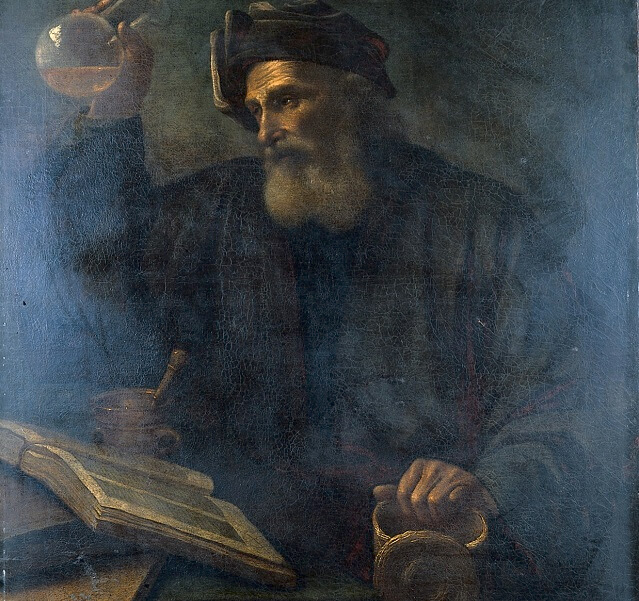
Illustration image: ‘A physician examining a urine flask’