With harsh words, the Torah admonishes a society where murderers can evade punishment through bribes:
Do not defile the land in which you live and in which I live. (Num. 35:34)
In what way does letting murderers go unpunished “defile the land”? And why does the Torah emphasize that this is the land where both we and God dwell?
The Sages taught in Shabbat 33a:
For the crime of bloodshed, the Temple is destroyed and the Shekhinah [God’s Presence] departs from Israel. As it says, Do not defile the land in which you live and in which I live. If you do defile it, you will not dwell in it, nor will I dwell in it.
Why is it appropriate to punish such a dysfunctional society with destruction of the Beit HaMikdash, loss of the Shekhinah, and exile?
The Impact of Murder
Clearly, a nation which suffers from rampant violence and bloodshed is not fulfilling its basic obligation to provide security for its citizens. But from an ethical-spiritual perspective, murder reflects a far more tragic phenomenon.
The Torah describes the Divine aspect of the human soul as tzelem Elokim. What is this “image of God”?
The Torah is teaching us that the Divine traits of good — the desire to help others, to give and nurture — are inherent to the human soul. Those who shed blood have corrupted their soul to such an extent that they have completely suppressed their innate tzelem Elokim. Instead of promoting life, they cause its destruction and loss.
Destruction of the Temple
The purpose of the Beit HaMikdash was not solely for the benefit of the Jewish people. When King Solomon built the Temple, he announced that it was also “for the stranger who is not from Your people Israel, but will come from a distant country for the sake of Your Name” (I Kings 8:41). The Temple was meant to be a “house of prayer for all peoples” (Isaiah 56:7). It was to be a focal point, spreading enlightenment and ethical teachings throughout the world.
However, in order to influence and inspire humanity, the ethical and spiritual state of the Jewish people must be strong. When Israel has fallen to cruelty and violence, what kind of moral influence can the Beit HaMikdash provide to the world? How can the Temple service inspire other nations, when they see that its values have not even succeeded in penetrating the Jewish people, repairing social injustice and eradicating bloodshed?
Unable to serve its universal purpose, the Temple was destroyed.
Loss of Divine Presence
This explains the connection between a corrupt society and the destruction of the Temple. What about the second consequence, the departure of the Shekhinah?
We must understand the significance of God’s Presence in Israel. The national soul of the Jewish people harbors aspirations far greater than normal social ethics. Our objective is not just to create a smooth-running social order that provides safety and security for its members. What point is there in creating a selfish, materialistic society, even if its citizens are protected from violence and instability?
This is where the Shekhinah comes in. The Jewish nation has an inner holiness that elevates the value of life itself. Through God’s Presence, the nation’s soul aspires to the highest and loftiest good possible. It strives to live according to the most elevated, Godly values.
But such goals are like building blocks. We acquire them step by step. The nation must first acquire the basic level, those common moral standards appreciated by all peoples. Only then is it possible to aspire to special levels of holiness. If the Beit HaMikdash is no longer standing due to a violent and immoral society, how can the nation’s soul attempt to elevate itself to its unique goals?
In such a state of corruption, the Shekhinah departs from Israel.
Exile from the Land
The third punishment for rampant corruption is exile. The dwelling of the Jewish people in Eretz Yisrael is tightly bound to its positive influence as a nation. Certainly much holiness and enlightenment can be gained from righteous individuals. But the impact of an entire nation, as it demonstrates holiness in all aspects of its national life, is of a far greater magnitude.
When Jewish people ceases to have a positive influence on other nations, as indicated by the loss of the Temple and the departure of the Shekhinah, then even their continued dwelling in the land of Israel is called into question. “If you defile the land, you will not dwell in it and I will not dwell in it.”
(Adapted from Ein Eyah vol. III, p. 188)
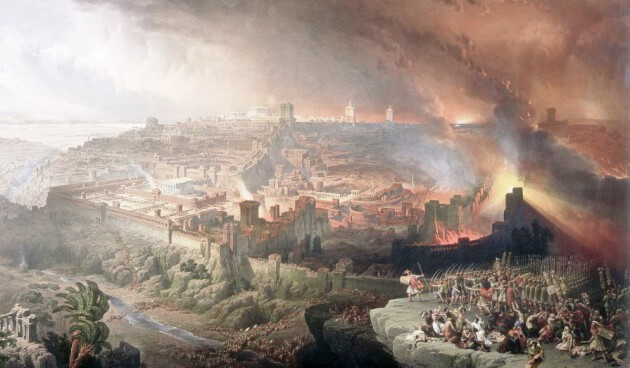
Illustration image: David Roberts: The Siege and Destruction of Jerusalem by the Romans Under the Command of Titus (1850)