Notarikon in the Torah
Abbreviations and acronyms are common in rabbinic writings, but they are rare in the text of the Torah itself. Nonetheless, the Sages observed that a few acronyms — notarikon in Aramaic — may be found in the Torah. The first and clearest example is the new name that God gave to Abraham:
“No longer shall you be called ‘Abram.’ Your name will be ‘Abraham,’ for I have made you the father of many nations.” (Gen. 17:5)
God changed Abram’s name to Abraham, explaining that this new name indicates his new identity and mission. The name Avraham is short for av hamon goyim, “the father of many nations.”
The Talmud (Shabbat 105a), however, was not satisfied with this interpretation of the name. While the Torah explains “Avraham” to be a syllabic abbreviation of the words av hamon, the Sages converted it into a full-blown acronym. They wrote that each of the six Hebrew letters of av hamon (אב המון) indicates a different aspect of Abraham’s standing and influence in the world.
Of all the names in the Torah, why is Abraham’s name an abbreviation? Why did the Sages further expand this abbreviation, letter by letter?
Abraham’s Dual Influence
It would be a mistake to consider a notarikon as merely a homiletic or mnemonic device. Rather, it reveals deeper levels of meaning in the text. In addition to a literal understanding of the words, there is a wealth of profound ideas contained within the written text. This is similar to the workings of an acronym, where from each letter we extrapolate an entire word.
Of particular interest is the example that the Sages chose for a notarikon in the Torah — the name “Abraham.” Why is this significant?
Abraham’s life-mission was to found the Jewish people. All three patriarchs, the Sages taught, are called “Israel” (Breishit Rabbah 63:3). This is because their primary goal was to establish the people of Israel, a unique people who would serve as a “kingdom of priests and a holy nation” (Ex. 19:6).
But Abraham also had a powerful impact on all nations. His teachings of monotheism transformed a world of paganism and idolatry.
The Sages analyzed Abraham’s influence, noting that it incorporated six qualities — corresponding to the six letters of אב המון. Thus, like a notarikon, Abraham’s influence was on two levels. His explicit life-goal was to found the Jewish people. But Abraham had an additional level of influence, as he disseminated his ideals of monotheism and morality among all peoples.
Six Aspects of Universal Influence
By examining each letter of the phrase av hamon, we uncover a different aspect of Abraham’s influence. He was an Av — a spiritual father and mentor to many nations, the source for true knowledge of God throughout the world.
His teachings were Bachur — select and distinct from the jumble of confused beliefs and superstitions held by the pagan nations. His faith in one God was pure, free of erroneous influences. Furthermore, his Torah enjoyed a charismatic attraction. Recognizing its inner truth and beauty, many were drawn to it and inspired by it. It was beloved and Haviv.
Due to his sterling character traits and beliefs, Abraham was highly respected. He was regarded as a Melech, a king. The people looked upon him as a “prince of God” (Gen. 23:6). Like a king in battle, he led the fight for truth in a world shrouded in darkness and ignorance, victorious by virtue of the truth of his vision.
Furthermore, Abraham’s Torah was not just some theoretical philosophy. He was Vatik among the nations — respected for his personal integrity and piety. Abraham sought to refine deeds and character traits through the holiness of his beliefs, and promoted a life of morality and justice.
The final quality of Abraham’s influence was Ne'eman — as a man of steadfast faith. As the Torah testifies, “He believed in God, and God counted it as righteousness” (Gen. 15:6).
Abraham and his radical ideas kindled a nascent spark of faith among the nations. This flame of faith continues to illuminate the paths of many nations — a flame that will be elevated in the future into a pure and refined faith in God.
(Adapted from Ein Eyah vol. IV, p. 264)
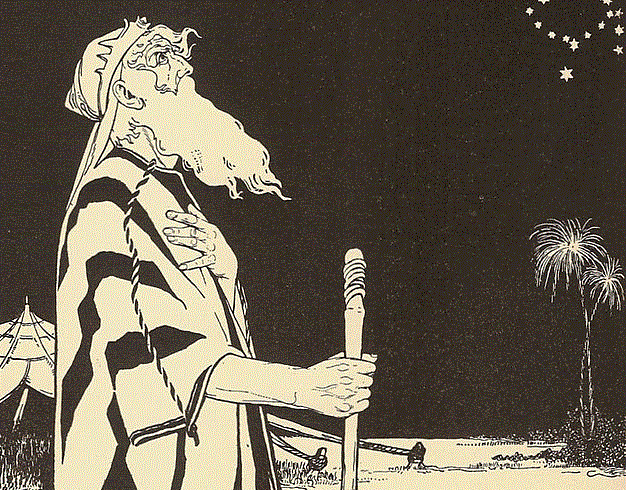
Illustration image: ‘Abraham contemplates the Stars’ (Ephraim Moshe Lilien, 1908)