Abraham, the Sages noted, was the first person in history to address God as “My Master” (Gen. 15:8).
What makes this event so noteworthy?
Completing the Master’s Work
We must first understand the essence of the servant-master relationship. The servant fulfills the wishes of his master by completing the master’s work. The servant is an extension of his master, his shaliach or agent. When the servant acts, it is as if the master has acted.
Before Abraham, people acknowledged the existence of a Prime Mover, an infinite Being Who created the universe. But they could not fathom how a truly perfect Being would be concerned with an imperfect and lowly world such as ours. Why would God, transcendent beyond all things, be involved in the smallest details of the workings of the universe?
They failed to recognize that an integral aspect of creation — its inner core — is that the universe aspires to perfect itself. This underlying aspiration for perfection and the world’s gradual moral progression is by plan and purpose; thus Divine providence governs all moral paths in the world, even the smallest and least significant.
The central conduit for the universe’s pursuit of perfection is mankind’s efforts to elevate its deeds, traits, and thoughts. We have free will to choose good or evil. And that which leads us to choose good over evil is God’s will stamped in creation, resulting in the universe’s inner aspiration to perfection.
By declaring God as his Master, Abraham publicly proclaimed that God governs the world and desires its moral perfection. God wills that we should be His agents in bringing about the world’s gradual advancement. As we work toward our own personal spiritual growth, we promote the work of our Master — the spiritual elevation of the entire universe.
(Sapphire from the Land of Israel. Adapted from Ein Eyah vol. I, p. 33 on Berachot 7b (I:77))
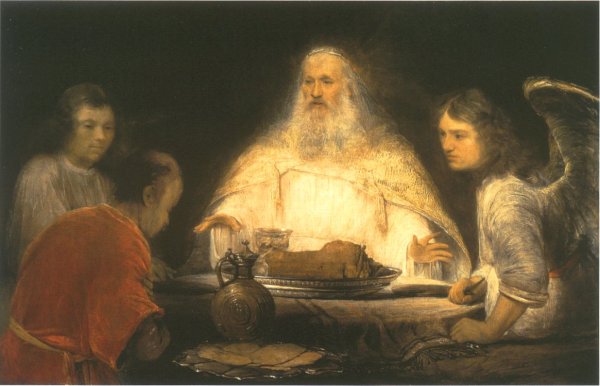
Illustration image: ‘Abraham and the Angels’ (Aert de Gelder, c. 1680–85)