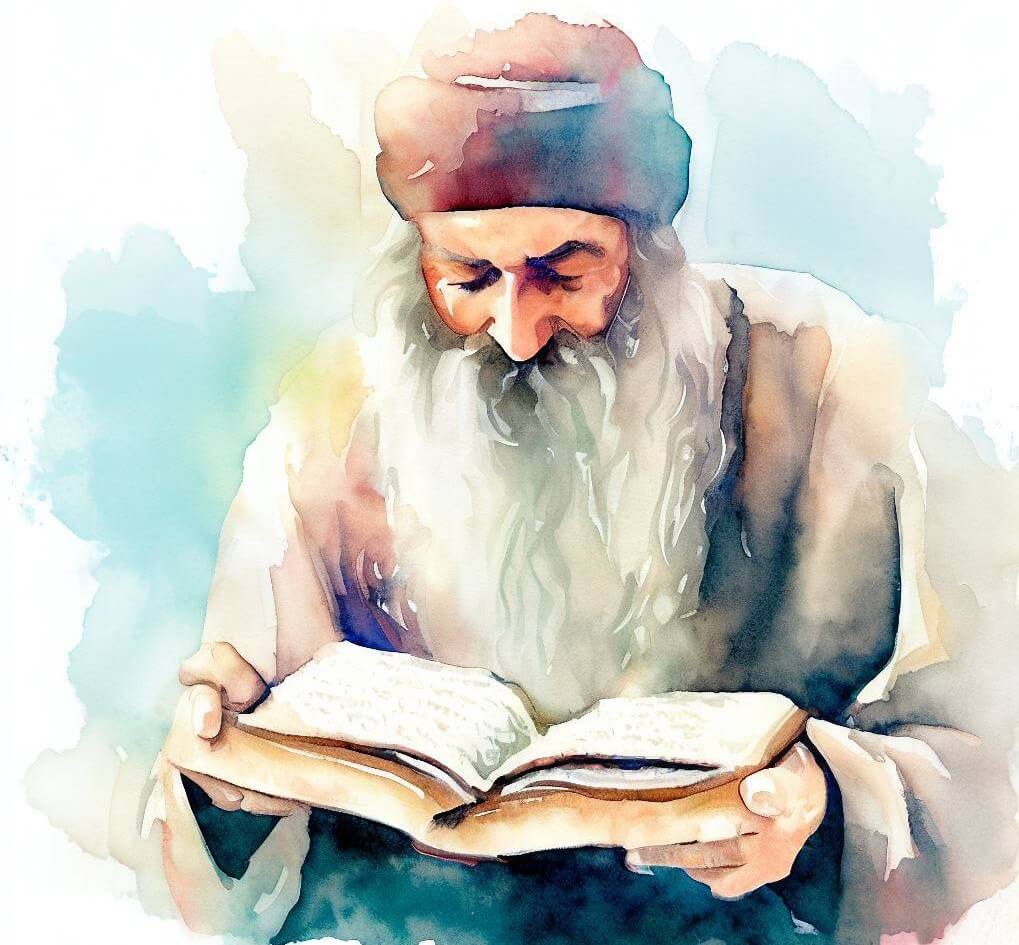
Abraham rose early in the morning, to the place where he had [previously] stood before God. (Gen. 19:27)
What does it mean that Abraham “stood before God”? The Talmud interpreted this phrase to refer to prayer. (The central prayer is called the Amidah, meaning “standing,” since it is recited while standing.)
A Set Place for Prayer
From the fact that Abraham returned to the place where he had prayed in the past, the Sages deduced that Abraham had designated a particular spot for prayer.
Rabbi Helbo said: Anyone who has a set location for his prayers will be assisted by the God of Abraham. And when he dies, they will say about him, ‘What a pious individual! What a humble person! He was a disciple of our forefather Abraham.’ (Berakhot 6b)
In what way is a person who sets aside a place for prayer a humble individual? What makes him a disciple of Abraham? Why is it so praiseworthy to always pray in the same location?
Spatial Holiness
We are accustomed to the idea that holiness is a function of space. Different places have different degrees of sanctity. The synagogue is holier than the Beit Midrash (the house of study),[1] the Beit Midrash is holier than an ordinary home, and an ordinary home is holier than the bathhouse. Levels of sanctity are also a geographic reality. The Land of Israel is holier than outside of Israel, Jerusalem is holier than other parts of Israel, the Temple Mount is holier than the rest of Jerusalem, and so on.
When examined by cold logic, however, our sense of holiness in space raises questions. Does not God’s glory fill the entire universe? Are not the limitations of space and location irrelevant to God? Why should it matter if I pray to him in the synagogue — or in the bathhouse? What difference is there to God between the inner sanctum of the holy Temple and a Los Vegas casino?
Elevating the Imagination
Rav Kook explained that a fundamental truth is at work here: whatever contributes to our ethical and spiritual improvement merits divine providence. Our moral perfection is dependent not only on the intellect, but on the refinement of all of our faculties, including our powers of imagination. Anything that elevates our emotions and imagination, directing them towards good deeds and refined character traits, merits divine providence.
A set location for prayer is a powerful mechanism for uplifting the imagination. Sanctity of place greatly enhances our sense of holiness. Because of its importance in developing this aspect of human nature, there is divine providence to help us succeed in this area.
Intellectual Humility
What makes this conduct humble?
The essence of religious humility is preventing the intellect from belittling matters of spiritual value, even though logically they appear to be baseless. We live not by the intellect alone. Good deeds are the ultimate measure of true living, and our actions are greatly influenced by our imagination and feelings.
Abraham exemplified this form of intellectual modesty. He arrived at belief in the Creator through his powers of logic and reasoning.[2] But when he was tested in the Akeidah, the Binding of Isaac, Abraham relied solely on his faith in God. He chose to disregard all arguments of reason and logic.
Anyone who follows in Abraham’s footsteps, and sets aside a special location for prayer, is elevating his imaginative and emotive powers. He is a disciple of Abraham, emulating his traits of humility and piety.
(Gold from the Land of Israel pp. 39-41. Adapted from Ein Eyah vol. I, p. 25)
One may not convert a Beit Midrash into a synagogue; it has greater holiness due to the Torah studied there (OC 153:1). On the other hand, due to the sanctity of a synagogue as a mikdash me'at (a Temple in miniature), any mundane activities, such as eating or sleeping, are forbidden. The Beit Midrash is considered the “home” of the scholars who study there, and they are permitted to eat, drink and sleep there (Mishna Berura on OC 151:1). ↩︎
See Maimonides, Mishneh Torah, Foreign Worship and Customs of the Nations 1:3. ↩︎