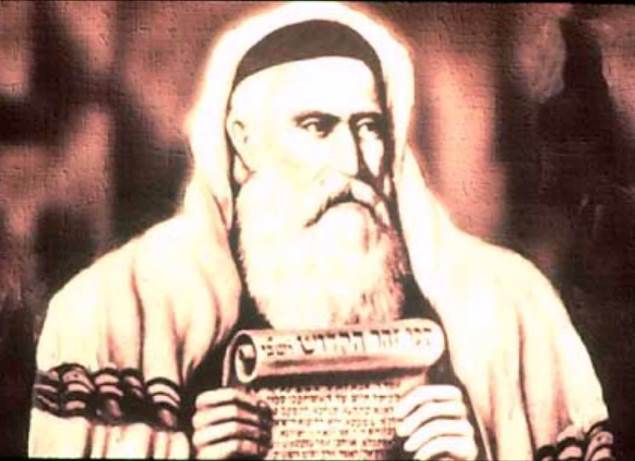
Leaving the Cave
With the death of the Roman emperor, Rabbi Shimon bar Yochai could finally leave the cave where he and his son had hidden for thirteen years, studying Torah as they lay buried in the sand. But the long years of deprivation and harsh physical conditions had taken a terrible toll on Rabbi Shimon’s body.
The Talmud in Shabbat 33b relates that Rabbi Shimon’s son-in-law, Rabbi Pinchas ben Yair, went to greet them. Rabbi Pinchas brought his father-in-law to the bathhouse and treated his skin. When Rabbi Pinchas saw the deep cuts in Rabbi Shimon’s skin, he began to weep. His salty tears fell onto Rabbi Shimon — and Rabbi Shimon cried out from the pain.
“Woe is me to have seen you in such a state,” Rabbi Pinchas lamented.
“On the contrary, you are fortunate to have seen me so,” replied Rabbi Shimon. “For if you had not seen me so, you would not have found in me that which you have found.”
What did Rabbi Shimon mean by this response? What benefit was there in the scholar’s deteriorated state of health?
Strength to Teach
A holy tzaddik like Rabbi Shimon, completely detached from the material world, gave little notice to his physical state. His uniquely elevated soul found comfort and joy in the light of a higher realm, a supernal light that alleviates all physical pain and suffering.
However, Rabbi Shimon’s ability to teach and influence others was certainly limited by his physical weakness and ill health. For this reason, Rabbi Pinchas cried when he saw his father-in-law’s physical state. "Woe is me to have seen you in such a state!”
A Higher Wisdom to Impart
Rabbi Shimon, however, disagreed with this assessment. Rabbi Shimon understood that, on the contrary, it was only due to his current state that he would be able to truly accomplish his mission.
The holy tzaddik was appalled by the widespread materialism and crassness in the world around him. The Talmud relates that when Rabbi Shimon and his son first left the cave, everywhere they looked was immediately consumed by fire. They could not reconcile themselves to society’s obsession with worldly matters. “They forsake eternal life and engage in temporal life!” they exclaimed.
If I wish to raise up those mired in the depths of materialism, Rabbi Shimon reasoned, I must first gain for myself a complete mastery over physical desires and transient matters.
Rabbi Pinchas realized that his father-in-law was only able to attain his unique spiritual level by neglecting his body during those long years of concentrated study and prayer in the cave. But Rabbi Pinchas failed to recognize that, beyond Rabbi Shimon’s own personal spiritual growth, this period also prepared him to influence others on a deeper level. Rabbi Shimon therefore explained to him, "You are fortunate to have seen me so.” Also for your sakes, it is good that I am the way I am. Now you will be able to gain far greater benefit from me. Now you will find in me a higher and more profound wisdom.
Rabbi Shimon’s response is now clear. “If you had not seen me so, you would not have found in me that which you have found.” Even "that which you find in me_” — even my ability to teach and enlighten you — is enhanced according to the quality of my soul’s inner purity, an inner aspect not bound by my abilities to communicate with others. The degree by which we are able to influence others is not only a function of rhetoric and eloquence. The extent of our influence primarily depends on an inner quality beyond words and language, a quality residing in the inner chambers of the soul.
The Talmud confirmed Rabbi Shimon’s insight with a simple empirical observation. Before he entered the cave, Rabbi Shimon would pose a question and Rabbi Pinchas would offer twelve solutions. After he left the cave, however, Rabbi Pinchas would be the one raising the question. And Rabbi Shimon’s enhanced wisdom was such that he would respond, not with twelve solutions, but with twenty-four.
(Silver from the Land of Israel. Adapted from Ein Eyah vol. III, pp. 208-209)