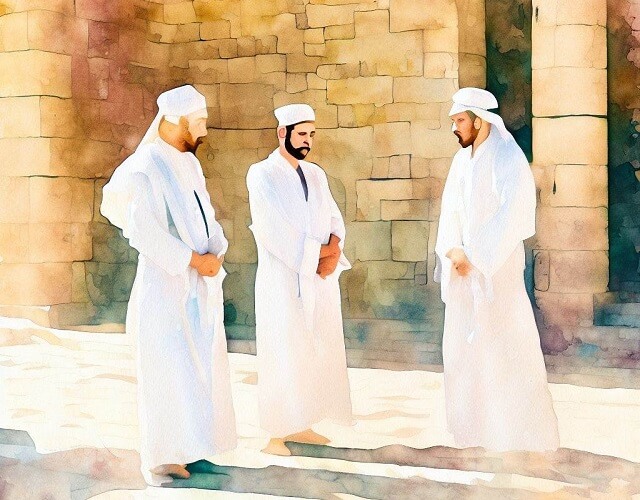
You have taken too much upon yourselves! All the people in the community are holy, and God is with them. Why are you setting yourselves above God’s congregation? (Num. 16:3)
Korach’s call for religious equality resonates well with modern, egalitarian sensibilities. Why indeed do the Jewish people need a special caste of priests? Why cannot each member of the nation participate in the holy service, personally offering up his own gifts to God? Why do we need kohanim to serve as intermediaries?
Specialized Sectors
To answer this question, Rav Kook employed the paradigm of the human body. Each organ performs a unique function, providing for the health and general welfare of the body. Despite their different qualities and tasks, the organs work together, functioning harmoniously as a unified organism.
Human society is also a living organic body, composed of various sectors and groups. Each sector — farmers, scientists, doctors, and so on — provides a specific service for the collective whole. These communal ‘organs’ meet society’s various needs according to their particular talents and training. As they work together and acknowledge the contribution of other sectors, they ensure the harmonious functioning and flourishing of the community as a whole.
The analogy may be extended further. Just as each individual is blessed with certain strengths and ambitions, so too each nation has specific talents and ideals. These national aspirations may be expressed in the sciences, art, philosophy, economic strength, etc.
Not every limb of a gifted individual is directly involved in his chosen profession. The artist utilizes the hand and eyes, the singer uses the voice, the philosopher uses the mind, and the Olympic runner uses the legs. It is similarly impossible for the entire nation to be directly involved in advancing the nation’s ideals. Each nation needs a cadre of spiritual leaders who cultivate the soul of the nation. This spiritual elite allows the other sectors to attend to society’s material needs, confident that the unique content that gives the nation its distinctive nature will not be forsaken.
Guarding Israel’s Spiritual State
The need for a spiritual leadership is even more pronounced when it comes to the Jewish people, whose national ideology transcends the physical world in which we live. All efforts made to advance the nation’s material welfare run the risk of diverting energy from the nation’s spiritual aspirations. As a mediaeval Jewish moralist commented, “Whatever builds up the physical detracts from the spiritual.”
Due to this concern, practical affairs are attended to in desultory fashion. In the end, both aspects are harmed. The nation’s spiritual efforts become disoriented due to its confused material state; and its physical state is weakened due to the coerced admixture of concern for spiritual matters.
Therefore, we need a cadre of lofty tzaddikim, blessed with breadth of knowledge, charged with securing the spiritual state of the nation. This elite is not perturbed if the rest of society cannot fully share in the richness of their spiritual life due to preoccupation with material matters. They know that spirituality will automatically permeate the nation due to the people’s natural inclination to holiness. These public servants represent the entire community, and they safeguard its spiritual treasure. The nation in return regards them as its most important assets, and honors them accordingly.
Radical Agents of Godliness
The Kohanim are mistakenly thought of as intermediaries between man and God. In fact, they are not meant to be intermediaries to God, but to enable immediacy to God.
When we approach God, we do not approach Him with our basest drives and inclinations, but with our holiest aspirations and desires. It is our elevated qualities which draw our entire being toward a Godly, enlightened life.
The same is true for the national organism. It is not right or even possible to approach God using society’s weakest elements. The nation cannot draw near to God with those who are preoccupied by lives confused by physical sensations and upheavals. This would lead to a feeble level of enlightenment, spiritually impoverishing the nation and the world at large.
Society therefore designated a special sector to enable the entire people to approach God. The lofty, righteous kohanim, steeped in kindness and elevated wisdom, truly know God. The rest of the nation relies on the holiness of their knowledge and emotions. The nation takes pride in the spiritual greatness of the kohanim; it is blessed through their blessing and sanctified through their sanctity. The people are bolstered with strength and inspiration as they work toward their material, social, and political objectives.
The need to appoint a select cadre of spiritual leaders reflects an innate aspect of human nature. Only after a long progression will this institution be truly revealed in all of its nobility — but we are not deterred by lengthy processes. We continue along the path we started so long ago, and we look forward to its completion and perfection.
To designate the entire people as priests, without distinctions, all equally wise and spiritually enlightened — this is not feasible in the world’s present state. Currently we need to aspire to a national spirit of holiness, by virtue of the nation’s noblest parts. The kohanim will serve as radical agents for sanctity and spirituality, enabling the entire nation to flourish in all endeavours, in its renascence of life in the Land of Israel.
(Sapphire from the Land of Israel. Adapted from Orot, pp. 53-55)