The Need For a Minyan
Judaism has an unusual concept called a minyan — a prayer quorum. Special prayers sanctifying God’s name, such as the Kedushah and Kaddish prayers, may only be recited in the presence of ten adult Jewish men. An individual may pray alone, but without a minyan, certain parts of the liturgy must be omitted.
Where does this requirement come from?
The Talmud derives it from God’s declaration, “I will be sanctified in the midst of the Israelites” (Lev. 22:32). What exactly does the word ‘midst’ mean?
We find the word ‘midst’ used again when God warned the people living nearby the dissenters in Korach’s rebellion: “Separate yourselves from the midst of this eidah (community)” (Num. 16:20). From here, the Sages concluded that God is sanctified within an eidah.
And what is the definition of eidah? The Torah refers to the ten spies who brought a negative report of the Land of Israel as an eidah ra’ah, an evil community (Num. 14:26). So we see that God is sanctified in a community of at least ten members.
The requirement for a prayer quorum, and the way it is derived, raises two issues that need to be addressed:
- Prayer appears to be a private matter between the soul and its Maker. Why should we need a minyan of ten participants in order to pray the complete service?
- Why is the requirement for a minyan derived precisely from two classic examples of rebellion and infamy — the spies and Korach?
Perfecting the Community
Holiness is rooted in our natural aspirations for spiritual growth and perfection. However, the desire to perfect ourselves — even spiritually — is not true holiness. Our goal should not be the fulfillment of our own personal needs, but rather to honor and sanctify our Maker. Genuine holiness is an altruistic striving for good for its own sake, not out of self-interest.
The heart of an elevated service of God is when we fulfill His will by helping and uplifting society. Therefore, the Kedushah prayer may not be recited in private. Without a community to benefit and elevate, the individual cannot truly attain higher levels of holiness.
This special connection between the individual and the community is reflected in the number ten. Ten is the first number that is also a group, a collection of units forming a new unit. Therefore, the minimum number of members for a prayer quorum is ten.
Learning from Villains
But why do we learn this lesson from the wicked?
It is precisely the judgment of the wicked that sheds light on the reward of the righteous.
If the only result of wrongdoing was that the wicked corrupt themselves, it would be unnecessary for the law to be so severe with one who is only hurting himself. However, it is part of human nature that we influence others and are influenced by our surroundings. The wicked have a negative influence on the entire community, and it is for this reason that they are punished so severely.
This also illuminates the opposite: the power of the righteous. Just as the wicked are judged not only for their own actions but for the harm they bring to the community, so, too, the righteous are rewarded primarily for the good they bring into the lives of others.
Now it becomes clear that true holiness is in the context of the organic whole. Thus the Kedushah prayer, sanctifying God’s Name, requires a minyan, a representative community of ten souls.
(Gold from the Land of Israel, pp. 258-260. Adapted from Ein Eyah vol. I, p. 104.)
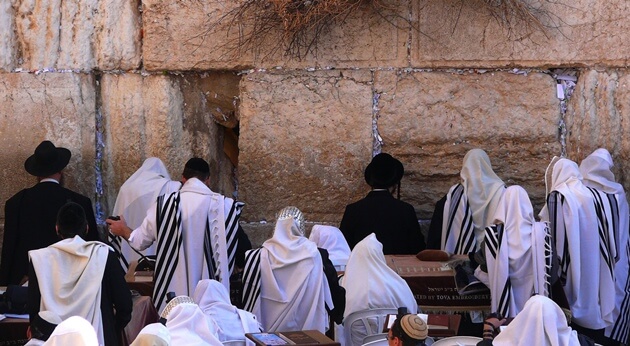
Illustration image: Religious Jews pray in the Western Wall, Jerusalem (Zachi Evenor, 2010)