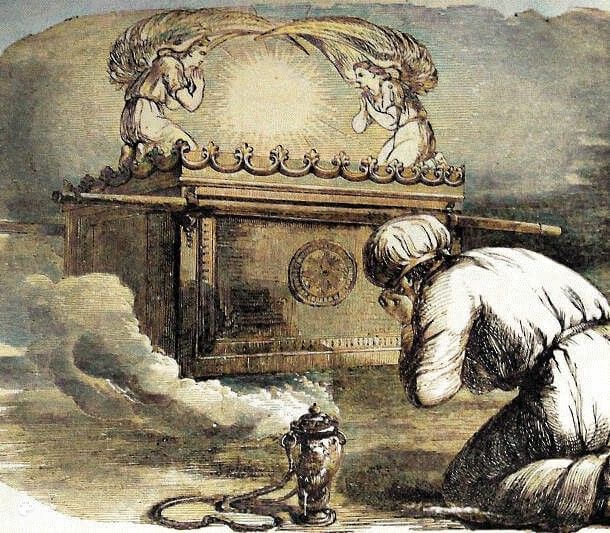
God said to Moses: Take fragrances such as balsam, onycha, galbanum, and pure frankincense, all of the same weight, as well as other fragrances. Make the mixture into incense, as compounded by a master perfumer, well-blended, pure and holy. (Ex. 30:34-5)
The Torah does not provide the exact recipe for the Ketoret, the incense that was burned daily in the Temple. Only in the oral tradition do we find a detailed list of eleven ingredients:
- 70 portions of the four fragrances mentioned in the verse.
- 16 portions of myrrh, cassia, spikanard, and saffron.
- 12 portions of costus.
- 9 portions of cinnamon.
- 3 portions of cinnamon bark.
Each portion (maneh) weighed five pounds. The total weight was 368 portions — one measure for each day, plus three extra measures for Yom Kippur. That’s 1,840 pounds (835 kilos) of incense.
Lofty Perspective
Why doesn’t the Torah explicitly list all of the ingredients of the Temple incense?
Rav Kook explained that the Ketoret was a link between the material and spiritual realms. The word ketoret comes from the root kesher, meaning a tie or knot. The incense rose in a straight column upwards. It was like a vertical band, connecting our divided physical world, our alma d'peruda, to the unified Divine realm.
From the elevated standpoint of overall holiness, it is impossible to distinguish between the distinct fragrances. Each fragrance signifies a particular quality; but at that elevated level, they are revealed only within the framework of absolute unity. It is only in our divided world that they acquire separate identities.
Sanctifying Time and the Natural World
What is the significance of the various amounts of each ingredient that went into making the Ketoret?
Each of the major four fragrances explicitly mentioned in the Torah contributed seventy measures. Why seventy? The number ’seven’ indicates the natural universe, created in seven days. Seven thus corresponds to the framework of the physical universe — especially the boundaries of time, and the seven-day week.
Seventy is the number ’seven’ in tens. The number ‘ten’ represents both plurality and unity, so seventy conveys the idea of unifying the multitude of forces in the natural world. This is the underlying message of the ketoret. These holy fragrances illuminate and uplift the plurality of natural forces in the world.
Sanctifying the Dimension of Space
While the first tier of four fragrances sanctified the dimension of time, the second tier of four fragrances sanctified the dimension of space. The number ’six’ corresponds to space, as there are six cardinal directions in three-dimensional space (north, south, east, west, up and down).
Time is less physical, and more receptive to spiritual elevation, than space. Thus, for the first four fragrances representing the dimension of time, the number ’seven’ was multiplied by ten. Space, on the other hand, is only influenced by its closeness to holiness. Therefore, the unifying quality of ten is only added to the six, so that the Ketoret used sixteen measures of these fragrances.
The final amounts of twelve, nine, and three signify the limitations of a non-unified spatial realm. ‘Three’ is the first number to indicate multitude, and ‘nine’ is the last number, before the multitude is once again combined into a unit of ten.
(Adapted from Olat Re’iyah vol. I, pp. 136-138.)